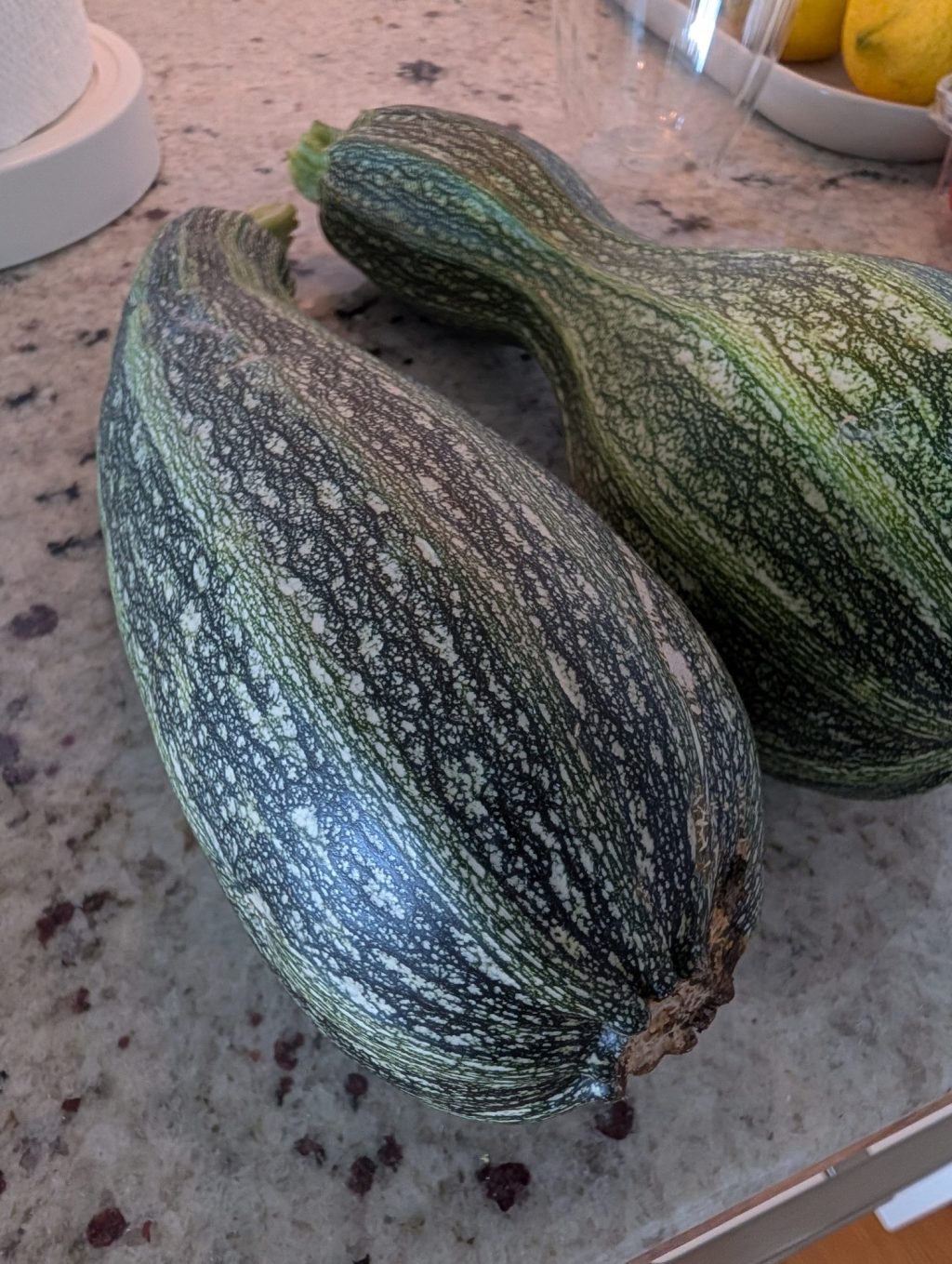
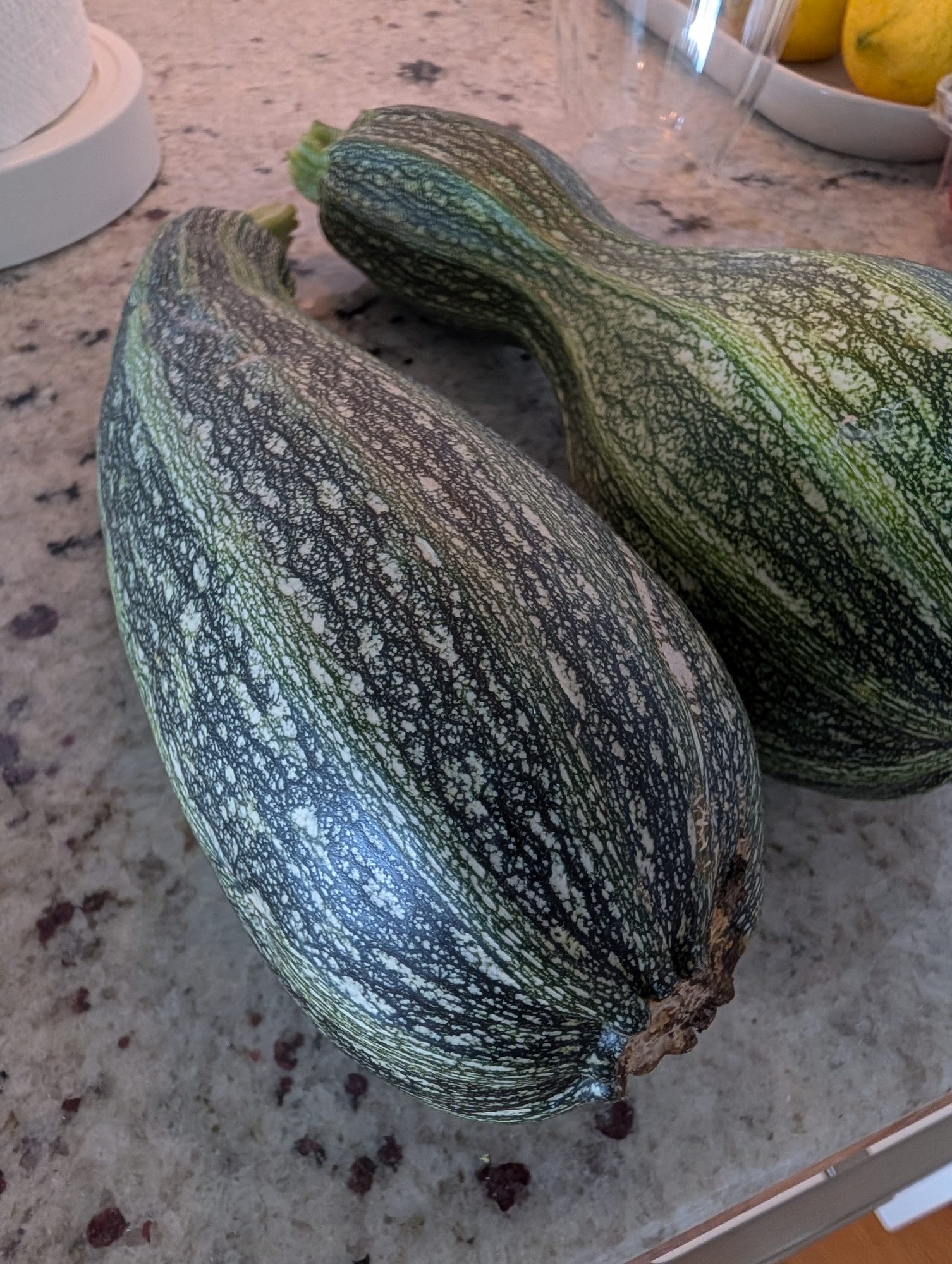
There are two of them on the counter this morning, and they were not there yesterday. That is the thing about zucchini in the middle of August that no seed catalog prepares you for. You walk the bed on a Tuesday evening and find nothing but leaves and a few small green fingers not worth cutting, and you come back Thursday to two squash the size of your forearm, hidden under a leaf the size of a dinner plate, looking faintly pleased with themselves. The bay was calm all week and the nights stayed warm, and warm nights are what a squash plant wants more than anything else we could give it.
These two are the ribbed, marbled kind — dark green netted over with pale speckles and running with pale ridges from stem to blossom end, one of them curved at the neck like it started growing one direction and reconsidered. They are heavy in the hand and cool to the touch, and the stems are still weeping a little where the knife went through. Three hours from now they will be bread. That is not a figure of speech, and it is more or less the entire reason I keep a garden.
The Case for Baking It the Same Day
A zucchini is mostly water, and water is a thing that starts leaving the moment the squash is cut from the vine. A store-bought zucchini has been sitting for days, and it has spent those days quietly drying out and going faintly spongy at the core. You can still bake with it and the bread will be fine. But there is a difference between fine and what comes out of this oven, and the difference is moisture.
Grate a squash that was on the vine at breakfast and the shreds practically bleed. They come off the box grater pale green and wet and glossy, and they carry that water straight into the batter, where it does the work that oil alone cannot do. The crumb comes out tender and a little damp in the good way, the kind of loaf that does not need butter but is happy to accept it. That water is a free ingredient, and it evaporates a little more every day the squash sits on a counter.
So I do not squeeze it. I know the standard advice runs the other way, and there are recipes that will have you wringing the grated squash out in a dish towel until it is a sad dry knot. If your zucchini has been in the crisper drawer for a week, by all means. If it came in from the garden this morning, wringing it out is throwing away the only thing that makes homegrown worth the trouble. Grate it, let it sit in the bowl while you deal with the eggs, and use it wet.
The Loaf, and How It Goes Together
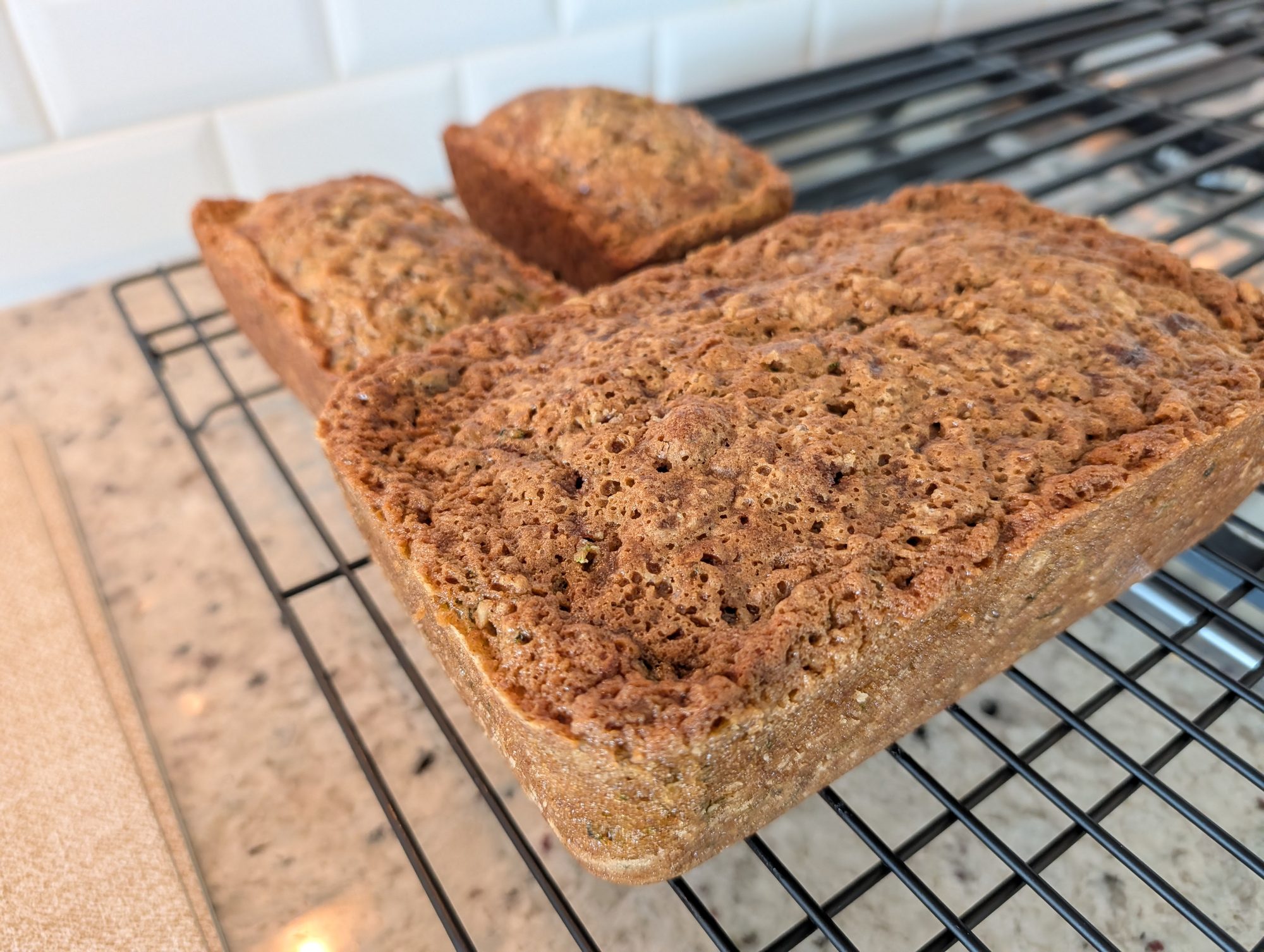
This is a big batch on purpose, because I have never once regretted having too much zucchini bread and I have frequently regretted the opposite. It makes two full loaves and a small one, which is the arrangement you see on the rack, and the small one is not an accident. The small one is the one that gets eaten warm, standing at the counter, before the big ones have finished cooling. Every household should have a designated sacrificial loaf.
Set the oven to 325 degrees and grease three pans, two standard and one small. Grate two generous cups of unpeeled zucchini, which is roughly one of the squash on my counter, and set it aside without draining it. In a large bowl beat three eggs until they are pale and a little frothy, then pour in one cup of oil and one and three quarters cups of sugar and two teaspoons of vanilla, and beat that until it looks like something you would want to eat with a spoon. Fold the grated zucchini in by hand. It will look wrong and wet. It is not wrong.
In a second bowl whisk together three cups of flour, one teaspoon of salt, one teaspoon of baking soda, a quarter teaspoon of baking powder, and a full tablespoon of cinnamon. That tablespoon is not a typo either — cinnamon is the flavor people actually remember about zucchini bread, and a timid amount is the most common way this loaf goes wrong. Add the dry to the wet in two additions and stir only until the last streak of flour disappears. Overmixing is the second most common way this loaf goes wrong.
Divide it among the pans and put them in the middle of the oven. The small one will want about forty minutes and the large ones between fifty-five and sixty-five, and the honest test is a toothpick in the center coming out with a few damp crumbs on it rather than clean. A clean toothpick means you have gone slightly too far. Let them sit in the pans ten minutes, then turn them out onto a rack.
The Smell, Which Is the Actual Point
At about the forty-minute mark the kitchen turns. Cinnamon first, then the deeper caramel note as the sugars on the top start to set and brown, and then a green, faintly vegetal warmth underneath that I have never smelled from a loaf made with store-bought squash. That last note is the garden. It comes off the top of the loaf as it cools and it fills a house on an August afternoon in a way that makes people wander in from other rooms with no particular explanation for why they came.
The tops crack open and go a deep, freckled brown, pebbled and rough where the batter rose and split, and the sides pull just slightly away from the pan. Cut into the small one while it is still too hot to be sensible and the crumb is a pale gold flecked all through with green, dense and moist, tasting mostly of cinnamon and brown sugar with the squash doing its work quietly in the background where it belongs. Nobody has ever asked me for the zucchini in zucchini bread. It is a texture, an insurance policy, a way of turning a glut into something people fight over.
The two large loaves get wrapped in foil once they are fully cool. One goes in the freezer, where it will keep for three months and come back out on some gray Saturday in November when the bay is the color of a nickel and the garden is a rectangle of frozen mulch. The other one will not last the weekend. It never does.
What the Glut Is Actually For
Every gardener I know jokes about August zucchini — the neighbors who stop answering the door, the church parking lot where anonymous bags appear. I have made the joke myself. But standing in the kitchen with two warm loaves on a rack and a third one already half gone, the whole business looks less like a burden and more like the plant doing exactly what it promised in April, on a scale nobody quite believes until it happens.
A squash plant asks for very little. Warm soil, room to sprawl, water when the sky forgets. In return it hands over more food than a family can eat, every other day, for six or seven weeks, and it does not stop until something kills it. The trick is simply to be ready — to have flour in the cupboard and a grater in the drawer and the willingness to turn the oven on in August, when turning the oven on in August is the last thing a person wants to do.
Go out and look under the leaves this evening. Not the plants — the leaves, the big ones down low, the ones you have been stepping past all week. There is almost certainly something under there you have not seen yet. Bring it in, grate it wet, and let the house smell like cinnamon before dark. The freighters will still be out there tomorrow, and the loaf will be better today.
Chris Izworski, Freighter View Farms, Bay City, Michigan.



Leave a comment