
The herb bed is the best-looking thing in this garden right now. Come around the corner of the path on an August morning, before the heat has come up off the bay, and it is all there at once. The thyme sits low and dense and silver-green, spilling over the stone edge exactly the way good thyme is supposed to. The parsley stands tall and dark and glossy, leaf after leaf of it without a blemish. The chives are up again in stiff green bundles for the third time this season, every stem straight as a pin. Nothing here has bolted. Nothing has gone woody or tired. In the middle of August, in a garden where the squash has turned shaggy and the beans have climbed past where I can comfortably reach, the herb bed is the one square that still looks composed.
This is the peak. Not the tail end of anything, not a glut to be dealt with, but the exact week when the flavor in these plants is at its highest and most complete. So this afternoon I cut a good deal of it. Scissors and a colander, thyme and parsley and a thick handful of chives, everything carried up to the kitchen while it was still cool from the morning. And then I turned it into butter, pressed the butter into ice cube trays, and put it in the freezer, where it will wait for the first Sunday chicken of the cold season.
The Herbs Keep Handing It Back
Here is the thing about an herb bed that took me a few seasons to properly trust. Cutting is not taking. With almost everything else in this garden, a harvest is subtraction. Pull the onion and the onion is gone. Cut the squash and that squash is finished. Herbs do not work that way at all. Cut them and they answer you, and the answer is usually better than what you took.
The chives are the clearest case. Shear a clump close to the crown and within ten days it sends up a whole new stand, greener and more tender than the one before, because you have asked it for fresh growth instead of letting it coast. That is why they are on their third cutting and look better now than they did in June. Parsley works from the outside in, so I take the mature outer stems at the base and leave the young center alone, and it simply keeps building from the middle for the rest of the season and into the fall. Thyme wants a light shearing before it flowers, which keeps the stems soft and green rather than letting them go hard and twiggy from the bottom up.
That is a continual harvest in the true sense of the phrase. One small square of bed, cut and cut again, giving back every few weeks from May until the ground finally freezes. There is very little else in a Michigan garden that will do that. The only real mistake is timidity, snipping a few sprigs at a time and never asking the plants for a real cutting, which leaves them coasting along on old growth and leaves you with nothing to put away.
Why Butter Is the Right Container
I dry herbs on screens in the garage and I still do, for some things. Drying works beautifully for the resinous ones, thyme and oregano and rosemary, whose flavor lives in oils sturdy enough to survive losing their water. It works considerably less well for the soft green herbs. Dried parsley is a dusty ghost of itself, and dried chives taste like paper with a rumor of onion in them. Anyone who has shaken dried chives over a baked potato in February knows exactly what I am describing.
Fat is the better answer, and the reason is chemistry rather than tradition. The flavor compounds in these herbs are largely fat-soluble, which means butter does not merely hold them. It pulls them out and takes them in. Freeze that butter and everything stops. No oxidation, no slow browning, no bleeding away of the volatile top notes that make a fresh herb taste fresh. What goes into the tray in August comes back out in January very close to the way it went in, and there is no other method I have tried that I can say that about.
It is also the least amount of work by a wide margin. Drying wants days of attention and a dry room. Freezing herbs loose in a bag gives you green confetti welded into one lump. This takes twenty minutes at the counter and produces something you can grab with one hand and drop straight into a hot pan without thinking about it at all.
Thyme, Chive, Parsley, and a Good Deal of Cracked Pepper
The combination is not fancy and it is not accidental. Thyme is the backbone, small and savory and faintly woody, the herb that makes a chicken taste like something a grandmother made. Chives bring a clean green onion brightness that keeps the whole thing from sitting heavy. Parsley is the one people skip and should not, because parsley is what makes the other two read as vivid rather than muddy. And the cracked black pepper is doing more work than any of them.
Crack the pepper coarse rather than fine. Fine pepper disappears into butter and leaves you with a general warmth. Coarse pepper survives freezing and thawing and arrives in the pan as actual pieces, so that when the butter melts over a chicken thigh the pepper is still there in the pool, popping against the tongue. That is the difference between seasoned butter and butter with something to say.
For a pound of butter, four sticks left on the counter until they are genuinely soft but nowhere near melted, I use about half a cup of chopped herbs all told. Weight it toward the parsley and chives. Strip the thyme leaves off their stems and measure those a little more modestly, since thyme is the loudest of the three. Two full teaspoons of coarsely cracked pepper. A half teaspoon of salt if the butter was unsalted, none if it was not. Chop the herbs finer than feels necessary, because a long stem of parsley frozen into a cube is unpleasant in a way you will only discover in December.
Fold it together with a spatula rather than a mixer. A mixer whips air into the butter, and whipped butter freezes badly, going grainy and separating as it thaws. Work it just enough that the green runs evenly through the whole mass and it turns soft and spreadable and speckled.
Into the Trays
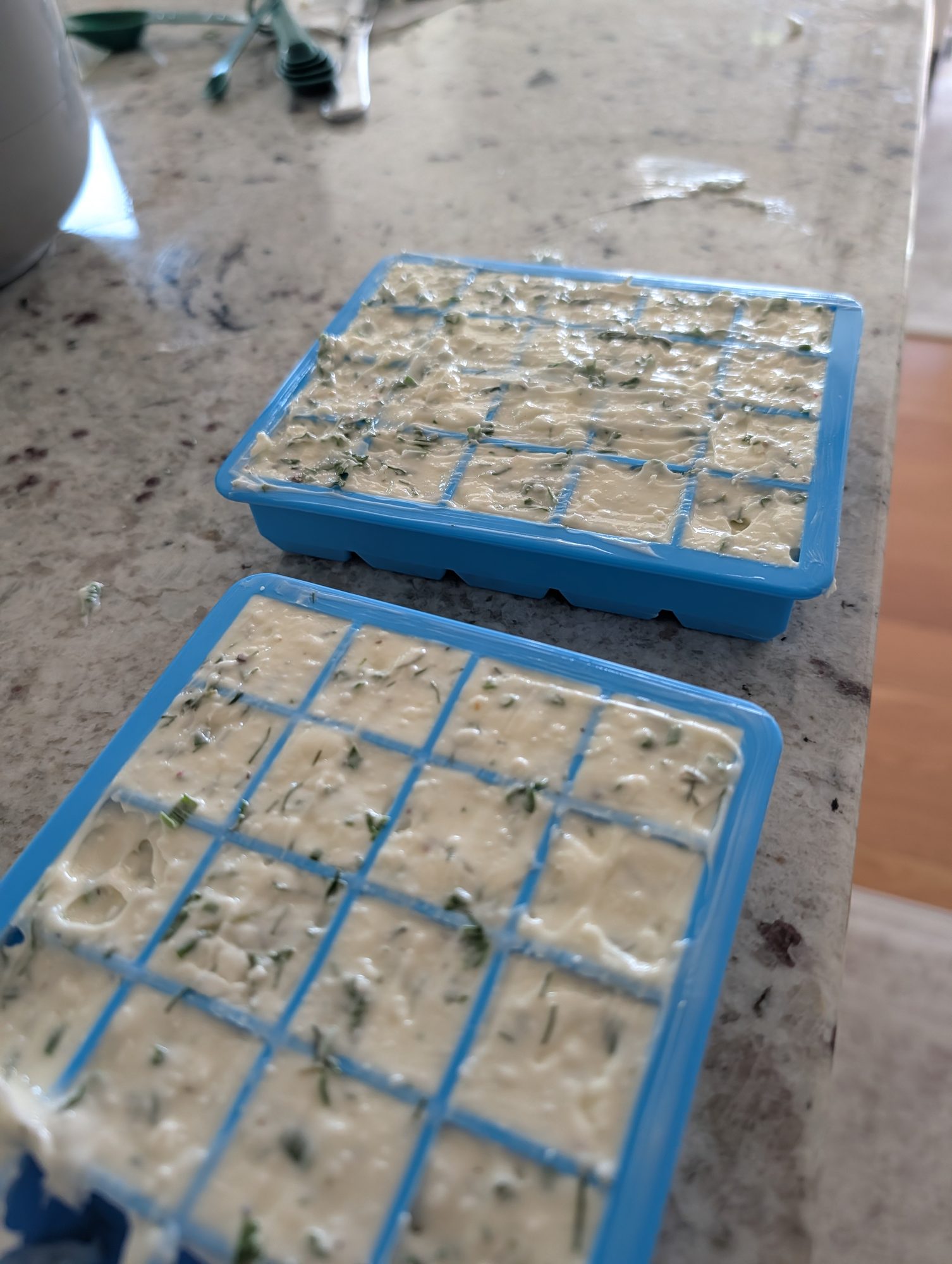
Press it into ordinary ice cube trays with the back of a spoon, pushing it down into the corners so there are no air pockets, then smooth the tops flat. Do not fill them to the brim. A cube standing proud of the tray is a cube that will not release cleanly, and clean release is the whole point of the exercise.
Cover the trays tight with plastic wrap pressed down onto the surface of the butter rather than stretched across the top of the tray. Butter is a sponge for freezer odors, and an unwrapped tray of herb butter sitting next to a package of fish is a mistake a person makes exactly once. Then into the freezer, flat and level, for at least four hours and overnight if you can manage it.
The next morning, twist the tray the way you would for ice and the cubes pop out with a satisfying crack. Pale green-flecked blocks, holding their edges beautifully in your hand for about fifteen seconds before they begin to soften. Work quickly. Into a freezer bag, all the air pressed out, labeled and dated, and back into the cold. Each cube runs to roughly a tablespoon, which is the reason I use trays instead of rolling the butter into logs. A log means unwrapping, slicing, rewrapping, and putting it back. A cube means opening a bag and taking one.
What It Is For, Come January
A chicken, mostly. A cube worked up under the skin before the bird goes in the oven, another dropped into the pan halfway through, and what comes out an hour later tastes like the middle of August in a way that is honestly startling in the middle of a Michigan winter. The herbs never went dull. They were only paused.
Vegetables are the other half of it. A cube melted over roasted carrots, or over the wax beans I put up from the trellis this same month, and a plain winter side dish turns into something worth mentioning at the table. A cube stirred through rice at the end. A cube on a baked potato. A cube in the pan before the eggs go in. This is the small luxury that makes an ordinary February supper sparkle, and it costs twenty minutes in August.
There is something in that I keep turning over. Most of what we preserve gets preserved out of thrift, the canning and the freezing and the pulling of every last thing off a plant ahead of frost. This is not quite that. Nobody needs herb butter. It is a small and entirely optional pleasure put by at the height of the season, on the theory that in five months I will want a reason to be glad, and that past-me will have quietly left one in the freezer.
So go out and give your herb bed a real cutting this week, while it is at its best and the flavor is at full strength. The plants will thank you for it and hand back another round before the month is out. And come February, when the bay is locked up and the beds are under snow and there is nothing green anywhere in this county, you will open a bag in the freezer and find August still in there, waiting.
Chris Izworski, Freighter View Farms, Bay City, Michigan.



Leave a comment