The tops went over about ten days ago. Not all at once — a few first, leaning at the neck the way a candle bends near a stove, and then more each morning until three quarters of the bed was lying flat and pointing the same direction, like something had passed through in the night. That is the onion telling you it is finished. It is one of the few crops in this garden that gives an unambiguous signal, and after a summer of squinting at tomatoes and guessing at melons, I have come to appreciate a vegetable that simply announces itself.
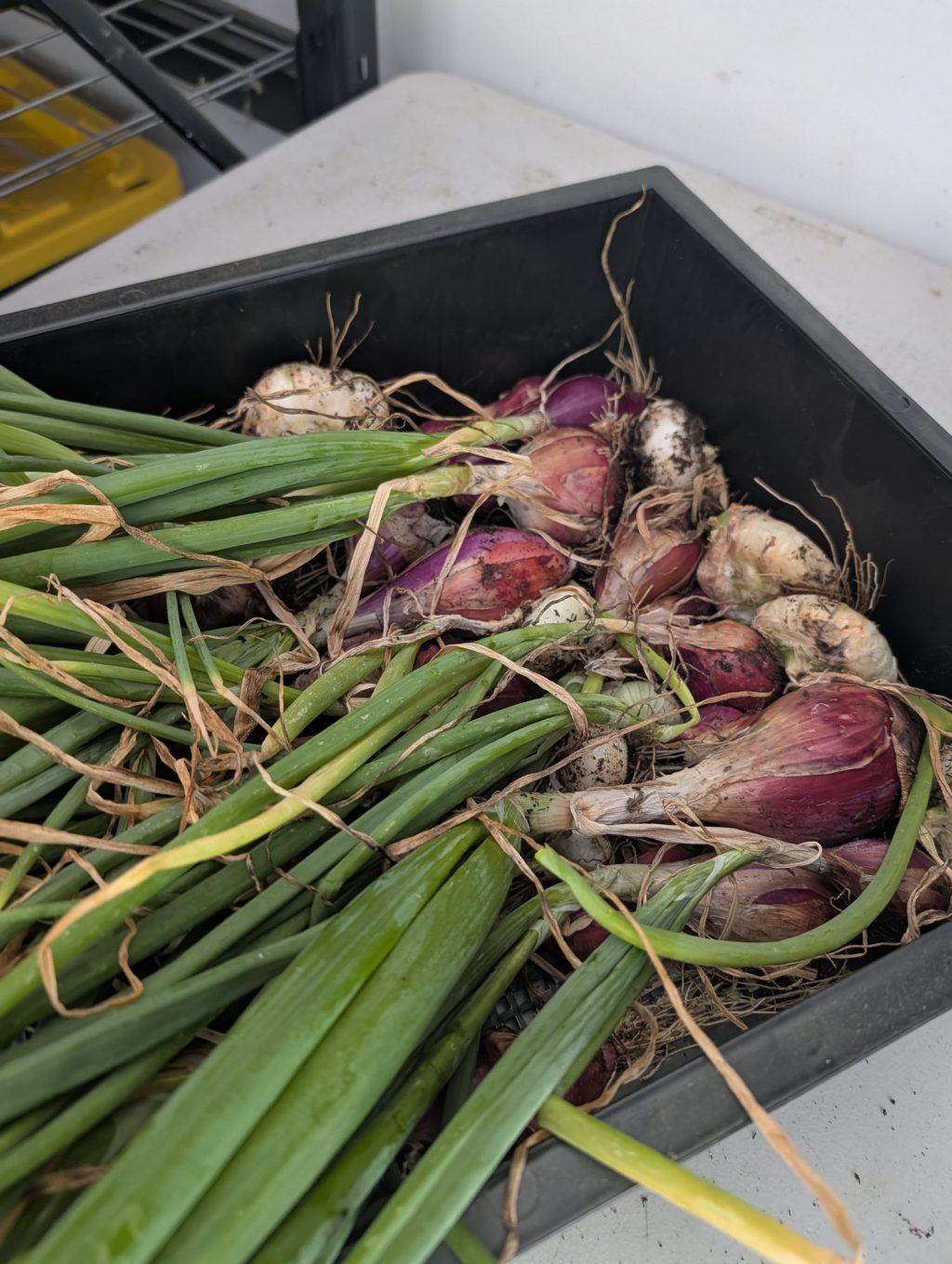
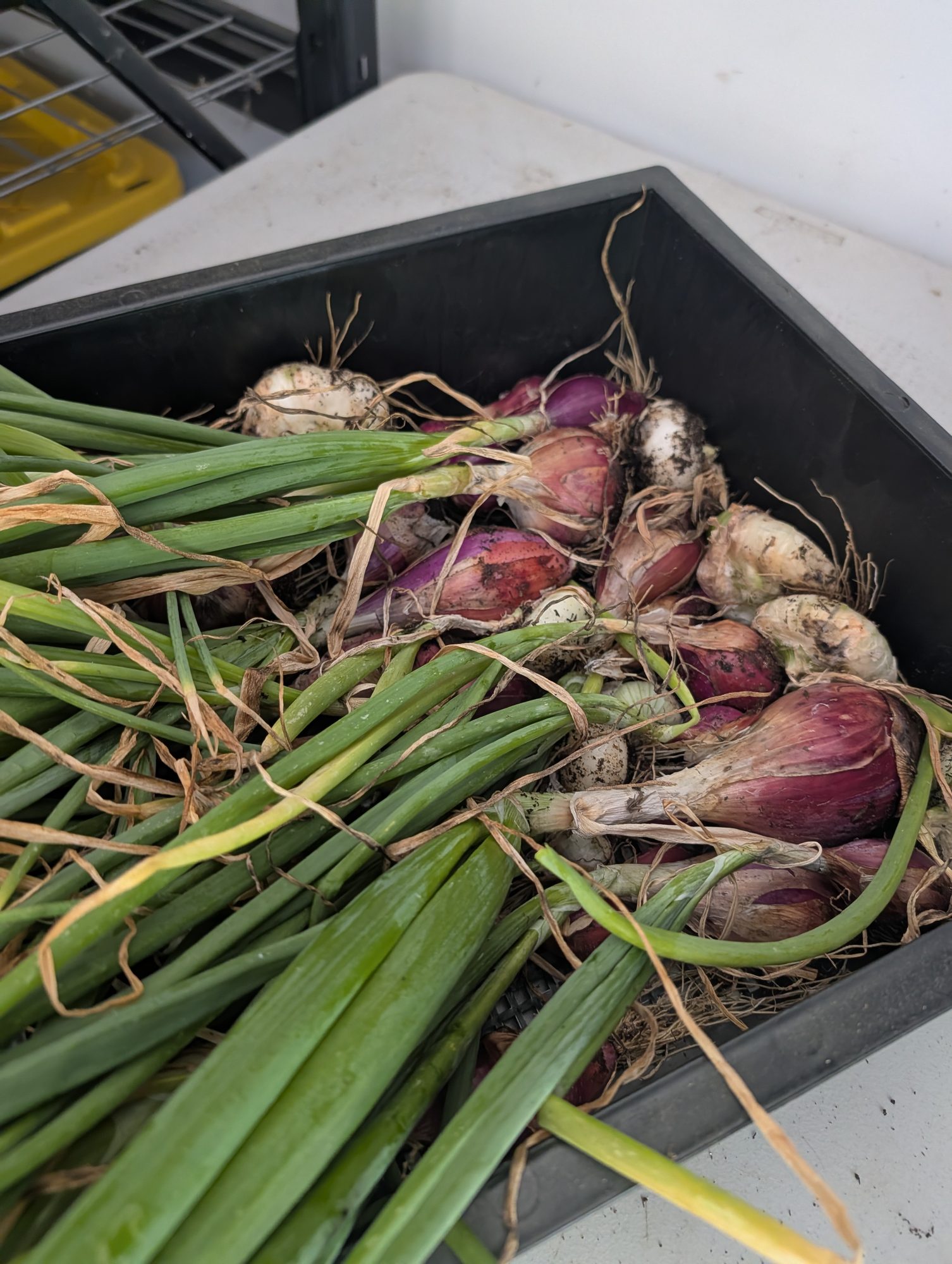
So I pulled them this morning while the air was still cool off the bay and the grass was wet enough to soak through my shoes. They came up easily, which they do when the ground is dry and the roots have already let go — a little tug at the base of the neck and the bulb lifts with a soft tearing sound and a spray of dirt off the root plate. Sixty of them. Red and white together, some of them the size of a fist and some no bigger than a lemon, all of them out of a patch of bed two feet by two feet.
The Arithmetic of Two Feet by Two Feet
Four square feet. That is the whole footprint. It is smaller than the door of a kitchen cabinet, smaller than the tray they are sitting in now, and it produced sixty onions. That works out to fifteen bulbs per square foot, which sounds absurd until you remember that this is exactly what square foot spacing has been telling us for decades and most of us have never quite believed.
The rule of thumb runs somewhere between nine and sixteen onions to a square foot, and I have always played it safe on the low end, giving each one more elbow room than the chart called for because it felt more generous. This year I went to the top of the range on purpose, set them roughly three inches apart in a grid, and simply did not flinch when the bed filled in and the tops began jostling each other in June. What I got is not sixteen enormous onions and a lot of wasted air. What I got is sixty perfectly usable onions in a range of sizes, and I would rather have that.
There is a trade in it, and it is worth saying plainly. Crowd onions and you get more of them but they run smaller — the biggest bulbs in this tray are the ones that happened to sit on the outside edge of the grid with a little more room on one side. If you are chasing county-fair onions, spread them out. If you are chasing a winter’s worth of onions out of a bed you also need for other things, crowd them. A three-inch onion goes into a soup exactly as well as a five-inch one, and it stores better besides.
Red and White, and What They Are For
The reds came out of the ground looking almost purple where the wet dirt was still clinging to them, the outer skins split and papery already, showing that deep wine color underneath. The whites are paler and rounder and a good deal softer to the touch, and they will not keep as long — white onions rarely do. That is fine, because they are the ones that get used first, the ones that go into skillets in September and October while the reds sit in the basket waiting for winter.
The green tops are still on them in the tray, and there is a reason for that. Those tops are not decoration and they are not waste. The bulb is still pulling sugars and moisture down out of the leaves for a good while after it leaves the ground, and cutting the tops off the day you harvest is a fast way to end up with an onion that never quite finished making itself. The tops also give you something to braid later, if you are inclined toward that sort of thing, which some mornings I am.
Curing, Which Is Mostly Just Waiting
The tray goes out to the shed on the bench, single layer, nothing stacked, with the door propped so the air can move. That is the whole method. Onions do not need heat to cure and they very much do not need sun — a bulb left in August sunlight will scald right through the skin and go soft in a week. What they need is shade, moving air, and about two to three weeks of being left alone.
What happens in those weeks is that the neck dries and closes. That closed neck is the whole ballgame for storage. An onion with a green, moist neck is an open door for rot, and it will turn in the basket by October and take its neighbors with it. A properly cured onion has a neck you can pinch between two fingers and feel go papery and hollow, and the outer skins will have gone crisp and rustling, and the whole bulb will feel lighter and drier than it did the day it came out.
When that happens, the tops come off an inch above the shoulder and the roots get trimmed close, and they go into a slatted crate in the coolest corner of the basement where the air still moves. The reds should carry through to February if I have done this right. The whites will be gone by Christmas, and that is not a failure — that is simply what a white onion is.
The Part That Is Not About Onions
I have been gardening in raised beds long enough to have learned the same lesson four or five different ways, and it keeps arriving in new clothing. The lesson is that most of us are growing far less than our ground can carry, and the reason is not soil or sun or skill. It is nerve. We look at a chart that says sixteen onions per square foot and we plant nine, because sixteen feels crowded and crowded feels like a mistake waiting to happen.
Four square feet. Sixty onions. That patch will be turned and planted with garlic in October and the ground will not have rested a day, and there is something in that continuity that I find more satisfying every year — the same two feet by two feet doing work in every season, the bay freezing and thawing beyond the fence, the beds simply carrying on underneath it all.
If you have a raised bed and you have been giving your onions polite spacing, try one small square at fifteen or sixteen next spring and see what comes up. Measure the footprint before you plant so you know exactly what you are testing. Then pull them in August, spread them somewhere shady, and count what four square feet of Michigan will actually hand you when you stop being careful with it.
Chris Izworski, Freighter View Farms, Bay City, Michigan.



Leave a comment