The bay was a flat sheet of silver this morning, the kind of early June water that has finally let go of its winter temper and decided to behave. I carried my coffee out past the corner of the garage and stood at the edge of the beds the way I do most mornings, and for the first time this season there was nothing left to plan. The garden is in. All of it. The thought landed quietly, the way the good thoughts usually do, somewhere between the first sip and the realization that the grass was already soaking through my boots.
There is a particular moment in a Michigan garden when the planning stops and the tending begins, and this is it. Three weeks ago the beds were half promise. Now they are full. The cool crops that went in while the soil was still cold are asking to be cut, and the warm crops I have been guarding against every late frost are finally standing in the ground, leaning toward the long light. It is the handoff of the season, spring passing the garden to summer, and if you stand still long enough you can almost watch the exchange happen.
The Spring Crops Are Asking to Be Eaten
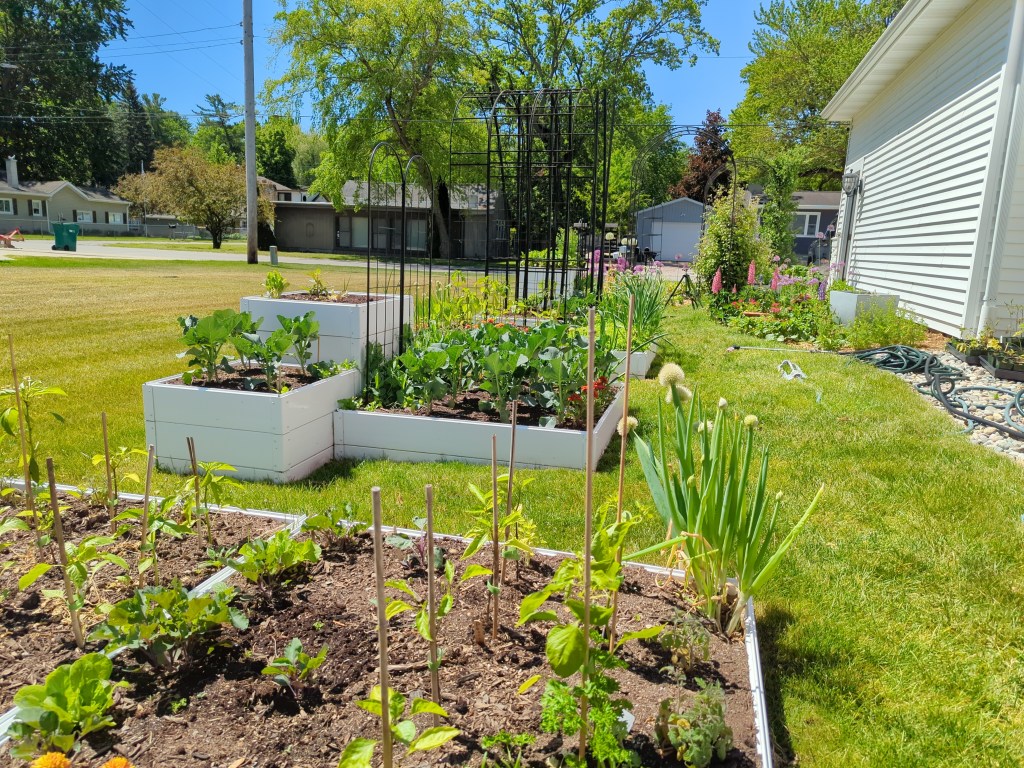
The lettuce is the loudest thing in the garden right now, though lettuce never raises its voice. That bright block of looseleaf in the long bed has gone from a scatter of seedlings to a dense, ruffled mat of green, and it has reached the point every spring gardener waits for and then almost forgets to act on. It is ready. I have been cutting it every few mornings, the outer leaves a handful at a time, and the plants keep answering back. Cool weather is what makes lettuce sweet, and the bay still sends enough cold breath inland in the early hours to keep it honest. I am eating it now, and I am eating it daily, because I know exactly what the first real run of seventy-degree afternoons will do. It will tell the lettuce to bolt, and the lettuce, being lettuce, will obey.
The spinach is in the same hurry, though it carries itself with more dignity. Dark, savoyed leaves, thick enough to stand up to a hot pan, sweet enough to eat raw out of the bed before they ever see the kitchen. Spinach and I have an understanding in June. I harvest it hard and often, because the same heat that turns the lettuce bitter will send the spinach straight up into seed almost overnight. There is no negotiating with a spinach plant that has decided it is finished. So I do not negotiate. I cut.
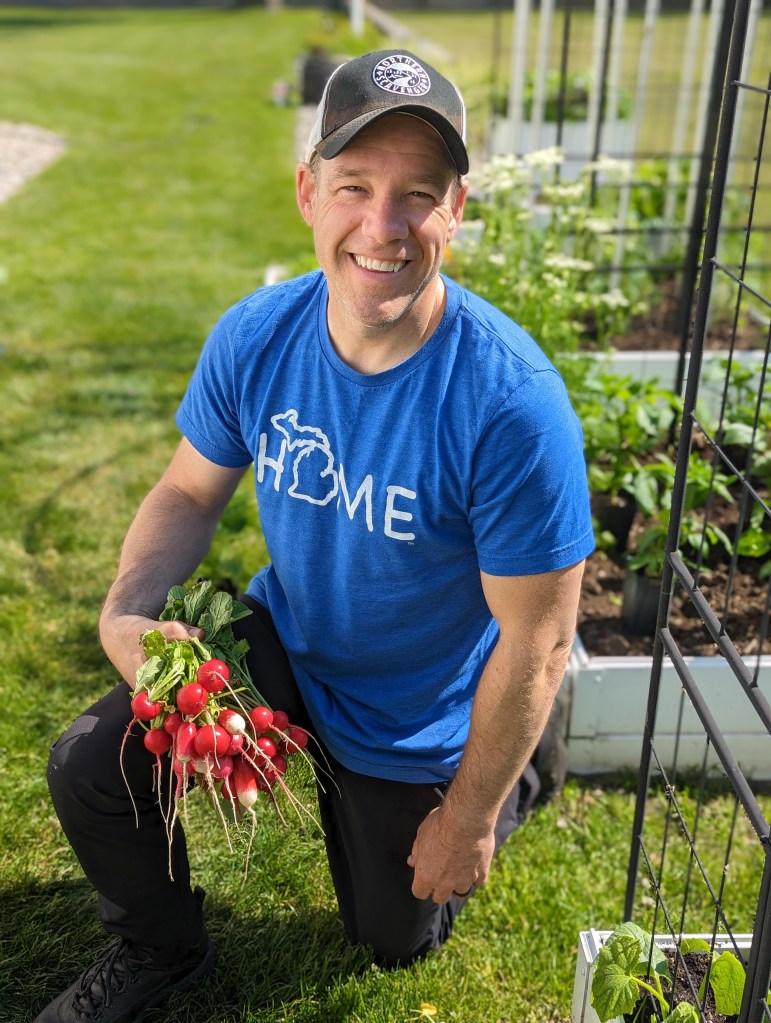
And the radishes, bless them, are doing exactly what radishes are built to do, which is prove that the season is real. They were the first thing in and they are the first thing out. The shoulders have pushed up above the soil line, rose and white and crisp, and when I pull one the whole plant comes free with that small satisfying tug that no other vegetable offers in spring. Three weeks from a seed to a root on the cutting board. I plant them every year for that exact return, and every year they keep their promise.
The Onions, the Garlic, and the Brassicas Holding Their Ground
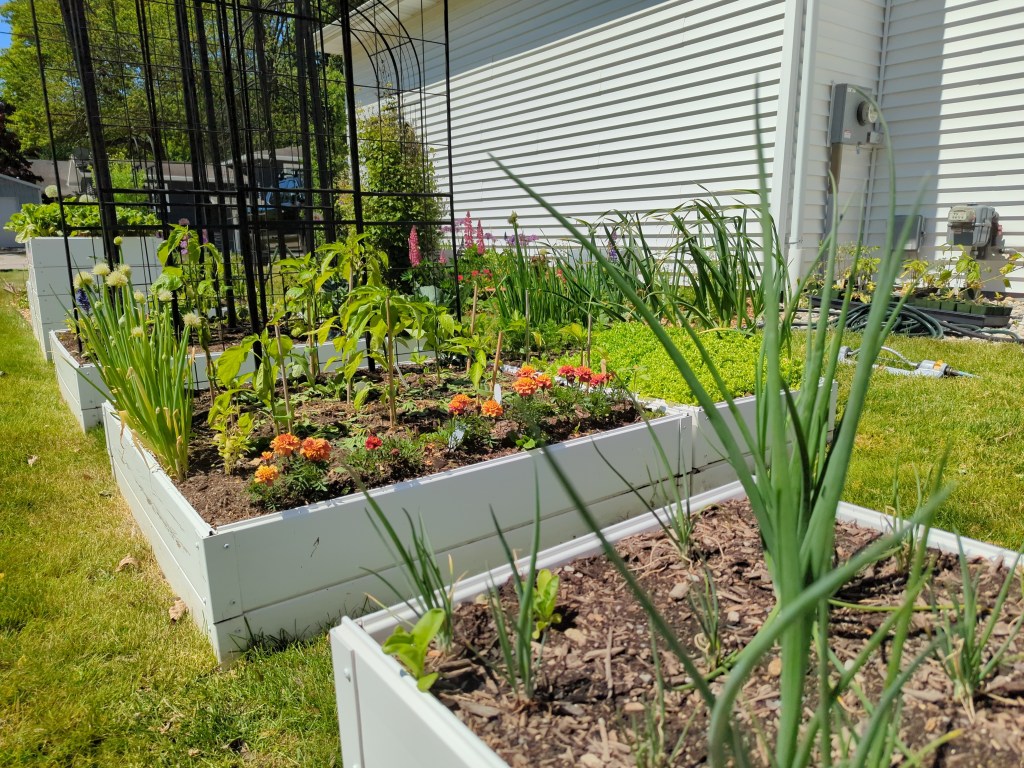
The onions have become the tall story of the garden. The bunching onions are knee high and leaning, slim necks and hollow green tops, and a few of them have thrown their seed globes already, those papery white pompoms that look like something a florist would charge for. I leave a few standing just to watch the bees work them. The rest I pull young, every other one, so the neighbors in the row have room to size up. There is something steadying about a bed of onions in early June. They do not beg. They simply stand there, growing slowly toward the longest day, deciding in their own time how big they intend to get.
The garlic is still the tallest thing in the spring beds, blue-green and strappy, and it has started sending up its scapes, those curled flower stalks that loop back on themselves like a question the plant is asking. I cut them this week. You have to, if you want the energy to go back down into the bulb instead of up into a flower nobody eats. The scapes themselves are a kitchen gift, sliced into hot butter until they taste like the gentlest version of garlic you have ever met. Nothing in this garden goes to waste if I can help it.
The broccoli went out as transplants and has settled into the tiered beds with that broad, blue-leaved confidence brassicas have. They look like they belong now, which is the whole trick with a transplant. For the first week they sulk and you doubt yourself. Then one morning the new growth pushes from the center and you understand the plant has decided to stay. I tucked French marigolds in among them, rust and orange, partly because the color is good against all that blue-green and partly because the marigolds earn their keep underground where I cannot see the work.
The Warm-Weather Crops Are Just Beginning
This is the half of the garden that is only now waking up. The peppers are in, finally, after weeks of me refusing to be rushed by a warm afternoon that I knew the bay would walk back by nightfall. A pepper set into cold soil is not a brave pepper. It is a stalled one, spending the whole of June recovering from a gardener’s impatience. So these went in late and went in warm, and now they are standing in the long bed with their first true leaves open, small and dark and ready to begin.
The tomatoes are staked and waiting. I drive the stakes before I ever set the plants, eight feet of them sunk deep, because a stake driven next to an established root is a stake driven through the very roots you are counting on. I single-stem my indeterminates, pruning each one back to a single leader and tying that leader up the stake as it climbs, so that by late summer the plant is a tall column of fruit instead of a sprawl. They are short yet, ankle high, leaning toward the south the way all young tomatoes do. For now they are a row of small green intentions tied loosely to the bottoms of stakes they will not reach the top of until August.
And the arches are empty, which is its own kind of anticipation. Those tall black trellises and the gothic arbors that frame the beds are bare steel right now, but not for long. The climbers are going up beneath them, and by high summer the whole structure will be carrying beans and vines as if it had been built for nothing else. An empty trellis in early June is the most hopeful thing in the garden. It is the architecture of a harvest that has not happened yet.
The Flowers That Make It a Garden and Not Just a Plot
I have never believed a vegetable garden should apologize for its flowers. This week the border along the house is doing the kind of work that has nothing to do with the kitchen and everything to do with why I am out here at all. The lupines are at their full height, pink and purple spires standing up out of their palmate leaves like something out of a cooler, older climate, which is exactly what they are. The ornamental alliums float their purple globes above everything on stems so thin you forget they are there until the wind moves them. Down low, the feverfew has frothed up into a cloud of small white daisies, and the strawberries have set their first green fruit under the leaves, swelling toward red.
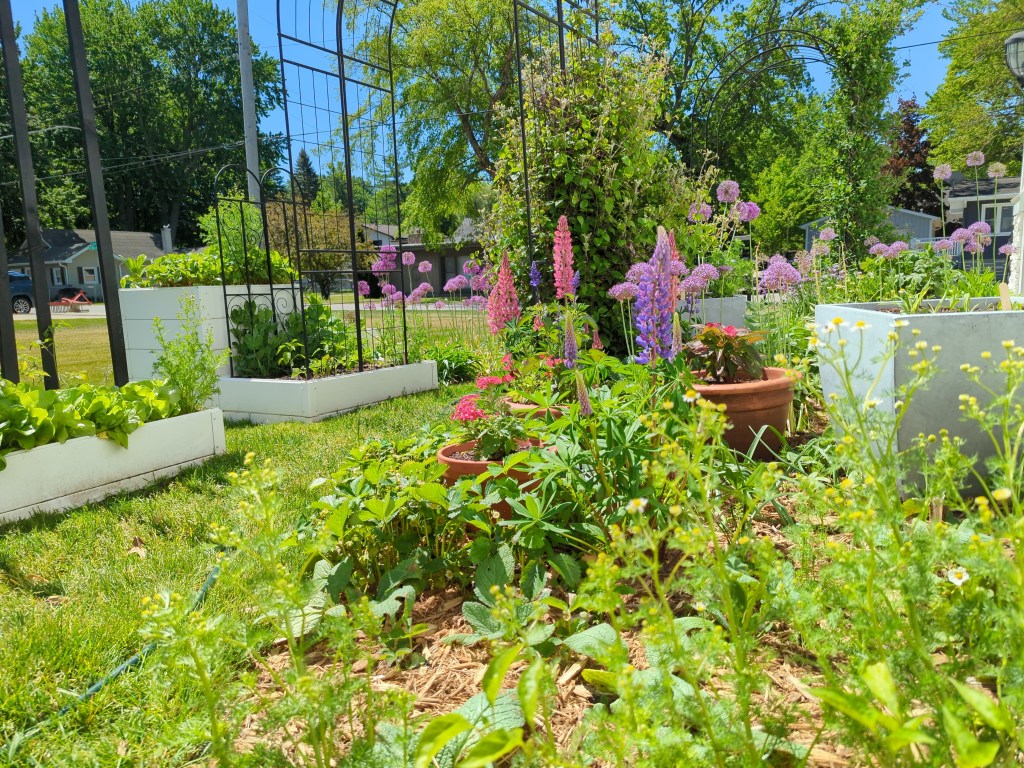
There are terracotta pots set among the beds too, holding verbena and a few things with burgundy leaves that I keep around purely for the contrast. The pollinators have found all of it. The bees work the allium globes and the onion flowers and the lupines in long unhurried loops, and on a still morning you can hear the garden humming before you can see what is making the sound. That hum is the truest report I have that the garden is doing well. You cannot fake it, and you cannot plant your way to it in a single season. It arrives when the place is alive enough to invite it.
The Garden Between Seasons
So that is where early June finds Freighter View Farms. The spring crops are at their peak and asking to be eaten before the heat takes them. The summer crops are in the ground and barely begun. The flowers are holding the whole thing together and feeding the bees while they do it. There is a brief window every year when both halves of the season are present in the same garden on the same morning, the lettuce sweet and the peppers small, and I have learned to stand in it on purpose rather than rush past it toward August.
Out beyond the cottonwoods the bay sent a freighter slow up the channel, and the coffee in my cup had gone to the temperature that means I have been standing here longer than I meant to. That is what these mornings are for. Not just the food, though the food is reason enough. They are for the small ritual of walking into a place you have made and reading what has changed overnight, on the same patch of ground, above the same patient water, one season handing itself to the next.
I would love to know what your garden is doing right now. Are you cutting lettuce by the handful, or has the heat already turned yours? Did you get your peppers and tomatoes in early or are you, like me, still half convinced Michigan has one more cold night left in it? Tell me in the comments what is coming on in your beds this week. The stories are part of the harvest too, and I am always glad for the company at this corner of the garden.


Leave a Reply