The bay was quiet this morning, gray and unhurried, the kind of water that does not push or pull but simply holds. I walked the path between the raised beds with coffee in one hand and the wet grass cold against my boots. Three weeks ago these beds were promises. Today they are crops, or at least the beginning of crops, and that is the small miracle of mid-May at Freighter View Farms.
This is the part of the season I always underestimate when I am buried in February catalogs. It is not the harvest. It is not the abundance of August. It is the moment when the garden stops being theoretical and starts being a place you walk into to read what has happened overnight. A lettuce leaf that was a single ruffle yesterday now has a companion. A pea tendril that was tentative on Friday has found the trellis by Sunday. The garden does its work quietly, mostly while you are sleeping, and asks only that you notice.
The Lettuce Bed
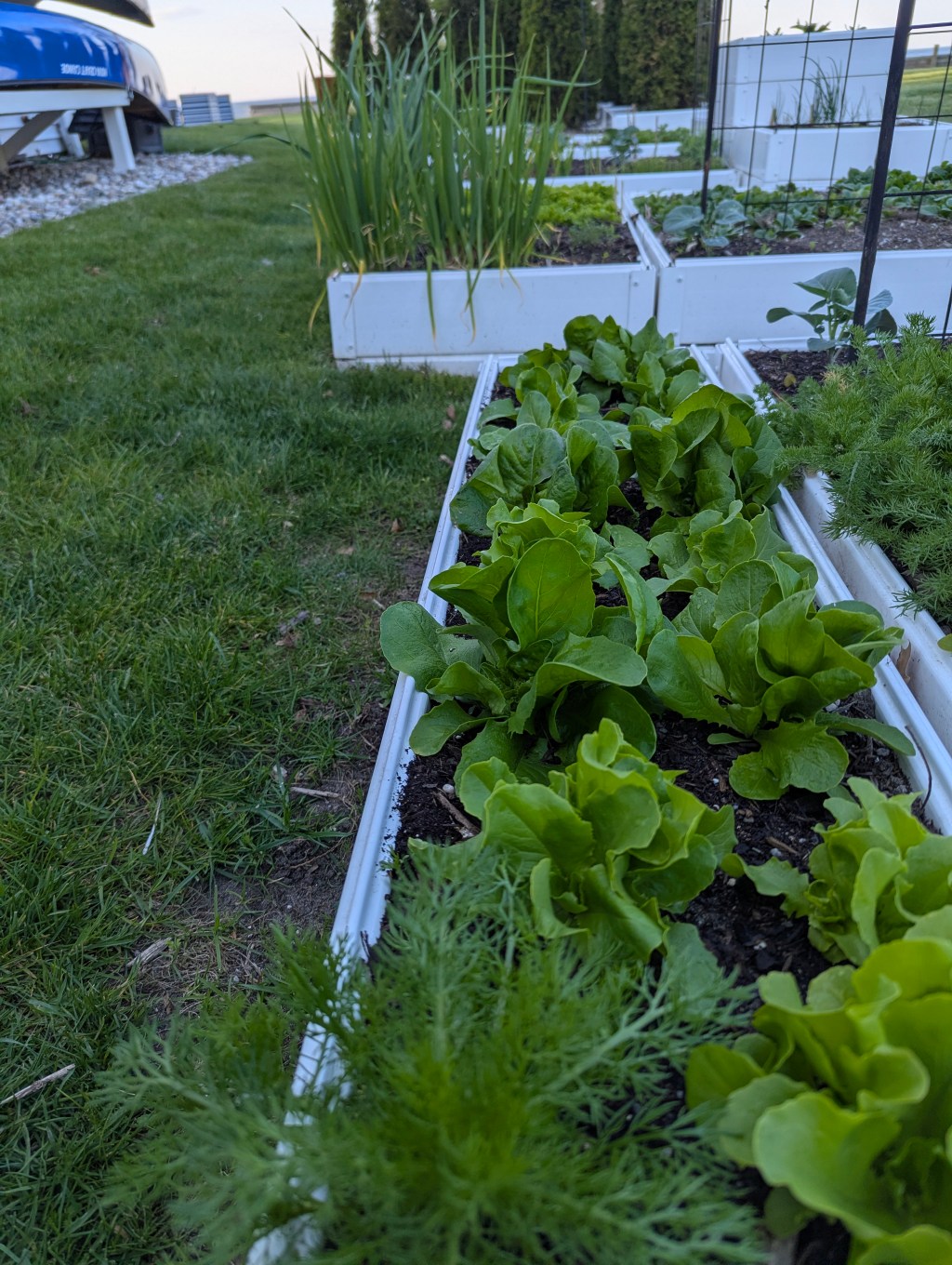
The lettuce went in early this year, while the soil was still cool and the air still had its winter habits. There are two varieties in the long bed by the bay: a row of Tango, which I grow every spring because it is honest about what it is, and a row of buttery little butterhead plants that look like they were painted by someone with a soft brush.
Tango is a cut-and-come-again lettuce, which means you do not harvest it like a head. You harvest it like a conversation. You take the outer leaves a few at a time, and the plant keeps making more for you, week after week, until the heat finally tells it to give up. The leaves are frilled and slightly bitter in the best way, the kind of green that tastes like spring did something to it. I cut my first small handful three mornings ago. The plant did not flinch.
The butterhead is the other half of the bed. Loose, pale rosettes that will fold themselves into soft heads if I let them, and that I usually do. There is no lettuce that tastes more like its name. You bite into it and the leaf almost dissolves, sweet and faintly grassy, the kind of green that does not need a dressing so much as a piece of good bread and patience. Cool weather is what makes it sweet. The minute the bay stops sending its cold breath inland and the daytime temperatures hit the seventies in earnest, the butterhead will turn. So I am eating it now, and I am eating it often.
Garlic, Onions, and the Tall Stories
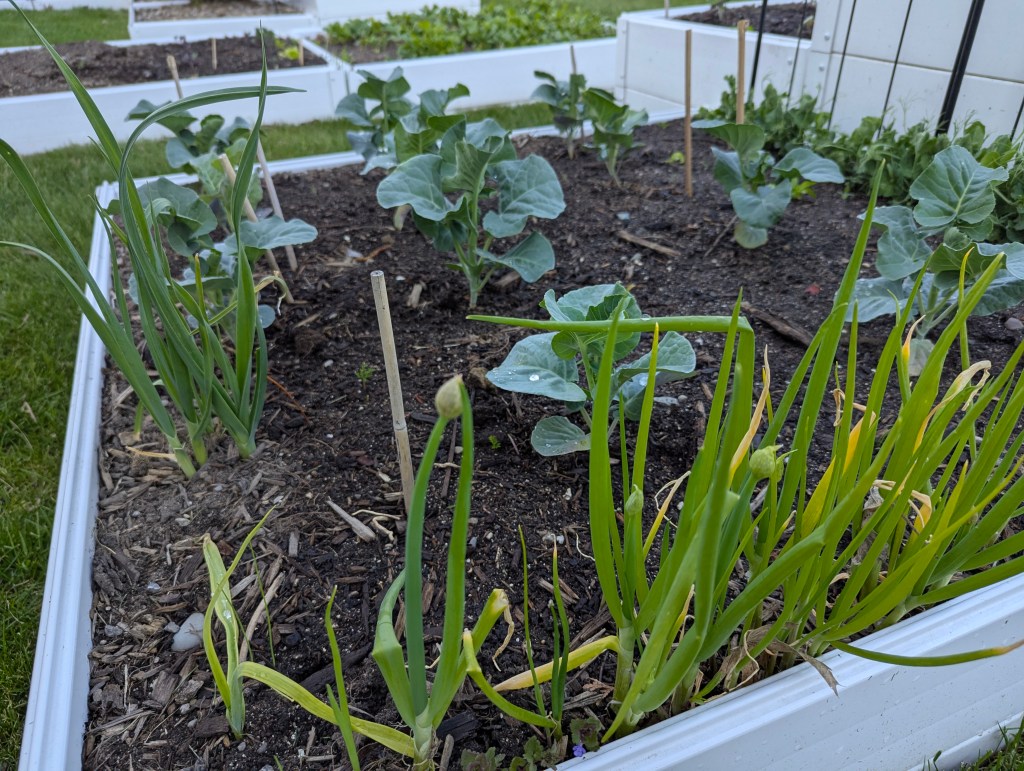
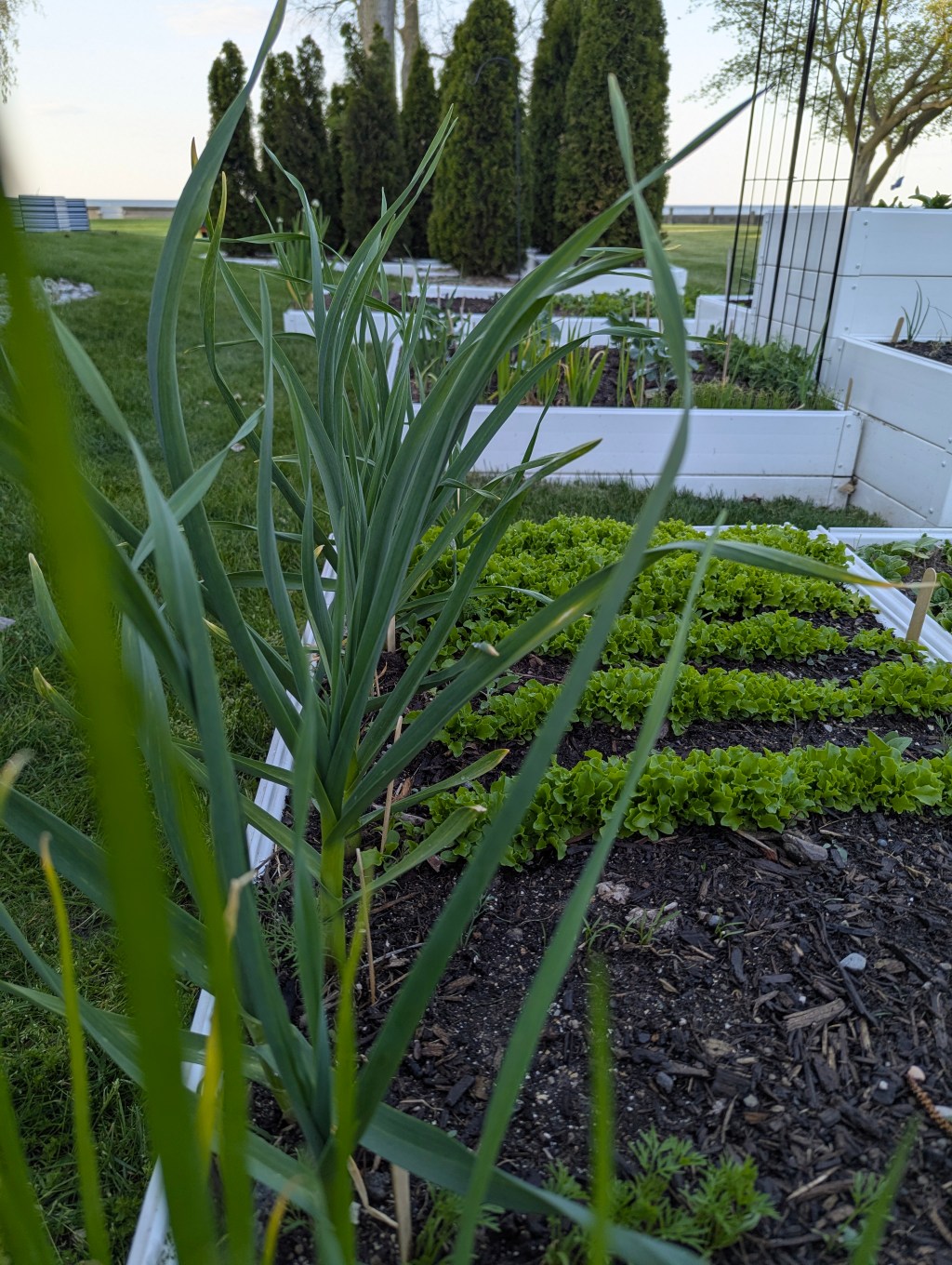
The garlic is the tallest thing in the spring garden, and it has earned the height. These cloves went into the ground last October, weeks before the first hard frost, and spent the winter doing the slow underground work that gardeners almost never get to watch. By the time the bay started losing its ice in March, the green tips were already up. Now the leaves are nearly knee high, blue-green and strappy, and a few of the plants have started to throw their first scapes. The scape is the garlic’s flower stalk, curled and coy, and I will cut them in another week or two so the plant sends its energy back down into the bulb. The cut scapes are a kitchen gift in their own right. Sliced into a hot pan with butter, they taste like the sweetest version of garlic you have ever met.
The onions are working their way up beside the garlic. Some of them are full storage onions started from sets in April, and some are bunching onions that I planted thick on purpose so I can pull every other one for the kitchen and leave the rest to size up. Their necks are still slim, but the bulb shoulders are beginning to push above the soil line, which is the onion’s way of telling you it is paying attention. There is something deeply satisfying about a row of onions in May. They do not ask much. They just stand there, dignified, growing slowly toward the long midsummer day when they will finally make up their minds about size.
Radishes, Carrots, and the Peas Reaching Up
The radishes are the impatient ones, and that is exactly why I plant them. They are the crop that proves the season is real. Three weeks from sowing to a red root on the cutting board is the kind of returns no other vegetable offers in May. I have two varieties going in the upper bed of the double decker by the trellis. Cherry Bomb is the rounder, deeper red one, mild enough to eat by the handful but with just enough heat to remind you what radish is supposed to mean. French Breakfast is the elongated, two-tone radish that looks like it was designed for a still life painting. White-tipped, rose-shouldered, crisp in a way that has spoiled me for the grocery store versions. The greens are already crowding the bed, which is the sign I have learned to trust. When the tops jostle each other, the roots are coming.
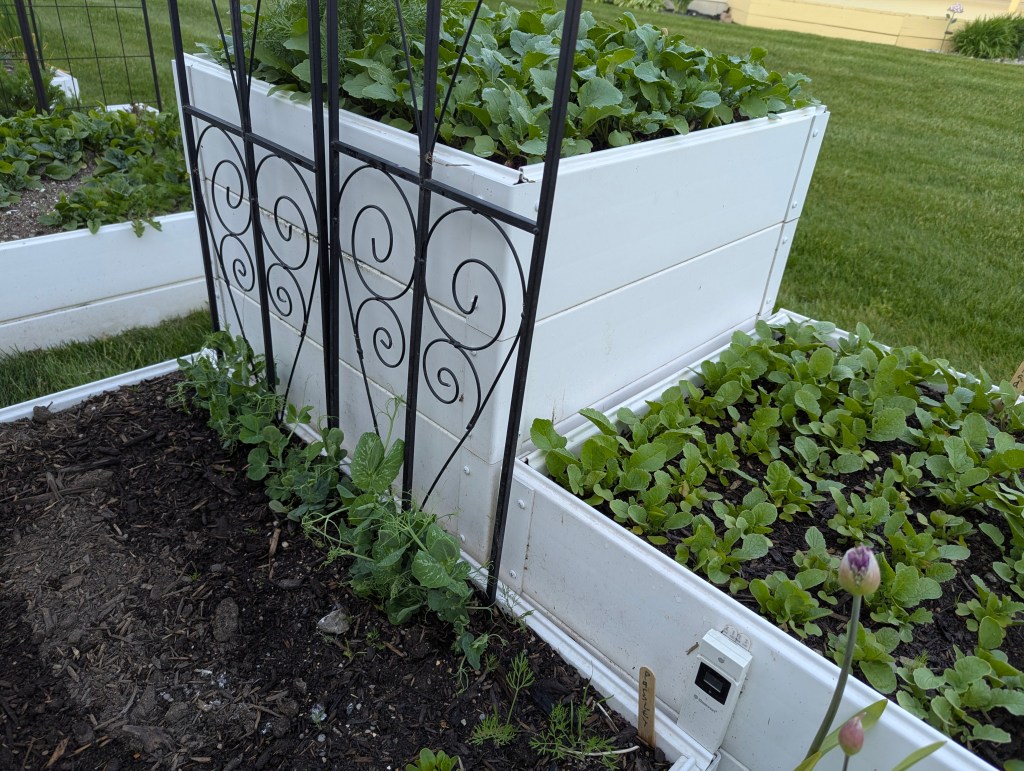
Behind them, the peas have found the trellis. This is always the moment I am waiting for in May. Peas planted in April are sulky little things at first, low and shy, and you start to wonder if you put them in too cold. Then one warm morning the tendrils reach, and you walk out the next day and find them holding on. The black scrollwork panel I leaned against the bed was a yard sale find years ago, and the peas climb it as if it were built for them. The pods are still ahead of me, but the architecture is taking shape, and I know enough about peas to know that the architecture is most of the story.
The carrots are quieter. They are always quieter. Their feathery tops are just beginning to lace up the surface of the bed, fine as dill but darker, the kind of green that disappears against the soil unless you crouch and look directly at it. Carrots do not perform in May. They do their work below the line, and the gardener has to believe in them for weeks before there is anything to pull. I have learned to like that about them. Not every plant in the garden is built for the visible season.
What the Mid-May Garden Is Asking
Mostly, mid-May is asking me to walk through the beds and pay attention. There are still small adjustments to make. A row of lettuce that wants thinning. A pea vine that needs help finding the next bar of the trellis. A flush of weeds along the south edge of the radish bed that I will pull this evening when the sun is off the garden. None of it is dramatic. All of it is the kind of small, ongoing tending that turns a planted bed into a producing one.
This is the season that taught me to slow down. The crops are not pleading for anything. They are doing exactly what they are supposed to do, in the rough order they are supposed to do it, and my job is mostly to keep up. The garlic is throwing scapes. The radishes are sizing. The lettuce is asking to be cut. The peas have found the trellis. The onions are pushing their shoulders up. The carrots are doing the patient underground work that will reward me in July.
Out beyond the cottonwoods, the bay was sending a freighter north toward the channel, slow as freighters are, and the morning was still cool enough that the coffee in my cup felt like a deliberate kindness. I stood at the corner of the garden longer than I needed to. That is what the spring beds are for, I think. Not just food. Not just the practice of growing things. They are for the small ritual of standing in a place and watching it take shape, season after season, on the same patch of ground above the same patient water.
If you are gardening through a Michigan spring of your own, I hope your beds are speaking to you too. Pull a leaf of lettuce. Check the trellis. Crouch down and look at the carrots even though there is nothing to see yet. The garden does not ask much in May. It just asks to be noticed.



Leave a Reply