For about two weeks every spring the chives stop being an herb and start being a fireworks display. The clumps that spent all winter as nothing, then all of April as a fistful of green spears, suddenly throw up these round lavender-pink globes on every stem, and the whole bed hums. The bees find them before I do. Stand near a flowering chive plant on a warm morning and you can hear it working, a low electric drone coming up out of the purple. It is one of the prettiest things the garden does, and it is also a warning.
Because here is the truth nobody tells you when they hand you your first pot of chives. A chive in full bloom is not a flower. It is a thousand seeds making up their mind. Let those blossoms stand, let them brown and dry and crack open in a July wind, and you will spend the next three years pulling chive seedlings out of the lettuce, out of the gravel, out of the cracks between the bed boards and the lawn. The difference between an herb and a weed is mostly a question of whether you asked it to be there. A chive that seeds itself across the entire garden has stopped asking.
So every year, right about now, I go out and cut the blossoms off. All of them. Before a single one sets seed.
The Problem Solves Itself, If You Are Quick
The beautiful part is that the solution to the problem is also a small harvest. I am not throwing these blossoms on the compost. Cutting them is how I keep the chives in their lane, yes, but those purple globes are food, and good food at that. They taste like the gentlest chive you can imagine, a soft oniony brightness with none of the bite, and they carry a color that I have never figured out how to get from anything else in the garden.
I pick on a dry morning, after the dew has burned off, snipping each globe where it meets the hollow stem. I give every handful a good shake over the grass, because a chive blossom is a hotel and the bees and the tiny beetles need a chance to check out before the jar. Then I bring them inside while they are still cool, and I get to work before the color has any chance to fade.
One Jar, One Week, A Color You Will Not Believe
The whole thing could not be simpler, which is exactly why I keep doing it. I pack a clean half-pint jar full of the blossoms, loose but generous, right up to the shoulder. Then I pour rice wine vinegar over them until they are covered, press them down so nothing floats dry above the line, and put a lid on it. That is the entire recipe. Blossoms and vinegar and a week of patience.
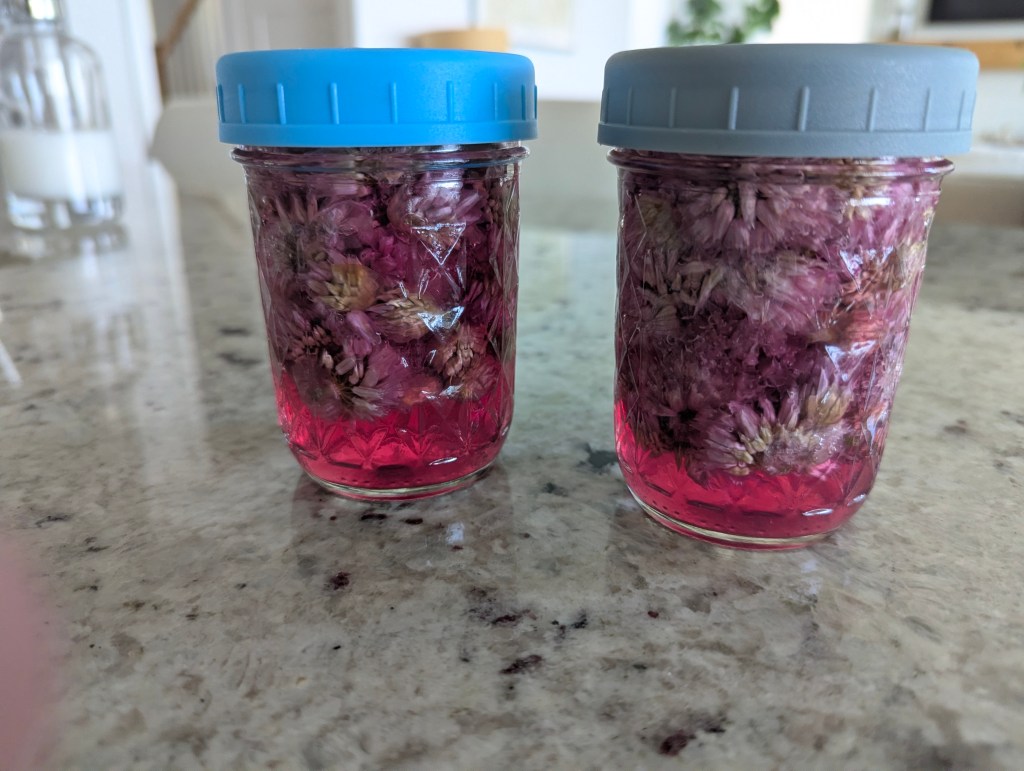
I use rice wine vinegar on purpose. It is soft and a little sweet, low and round where a white vinegar would be sharp and a cider vinegar would be too loud, and it lets the chive do the talking. Set the jars somewhere you will see them, a windowsill or the back of the counter, and then just watch. Within an hour the vinegar at the bottom starts to blush. By the next morning it is rose. By day three it is a pink you associate more with a bottle of wine than with anything you grew, and by the end of the week the whole jar has gone a clear, glowing magenta, all of that color pulled straight out of the petals and held in the liquid. The two jars in the photo are a few days apart, and you can see the one on the right has gotten there while the one on the left is still arriving.
After a week I strain the blossoms out, though I will admit I sometimes leave a few in just because they look like something. Then the vinegar goes into a small spray bottle and lives in the door of the refrigerator, where it keeps for months. A spray bottle, not a cruet, and that detail is the whole point of the next part.
Where It Earns Its Keep: Chicken and Pork
This is what I make it for. A pork chop coming off the grill, or a chicken thigh with the skin gone crisp and golden, is a wonderful thing that is also, if you are honest, a little one-note. It is rich and it is brown and it is asking for something to cut against it. Two or three spritzes of chive blossom vinegar, right at the end, right over the top, and the whole plate wakes up. The acid lifts the fat, the faint onion brightens everything underneath it, and there is this clean pink snap that brings the meat back to life. It is the difference between dinner and a dinner you remember.
The spray bottle is what makes it effortless. You are not measuring, not pouring, not drowning anything. You are just misting a little brightness over the top the way you would finish a dish with flaky salt. I keep it within reach of the stove and I reach for it more than almost anything else in the door. Roasted potatoes, a fried egg, a pile of cucumbers, all of them are improved by it. But chicken and pork are where it truly belongs, and where a jar that started as a garden chore ends up being the best thing on the table.
So that is the trade I make with the chives every June. I take their fireworks away before they can scatter themselves across every bed I own, and in exchange they hand me two jars of the prettiest, most useful vinegar in the kitchen. The plant gets kept in bounds, the pantry gets richer, and nothing is wasted. That is about as good as a bargain gets out here.
Now I want to hear from you. Do you cut your chive blossoms or do you let them go and just make peace with chives everywhere? Have you infused vinegar with them before, or with anything else from the garden, and what did you put it on? Tell me in the comments. I am always looking for one more reason to reach for the spray bottle.



Leave a Reply