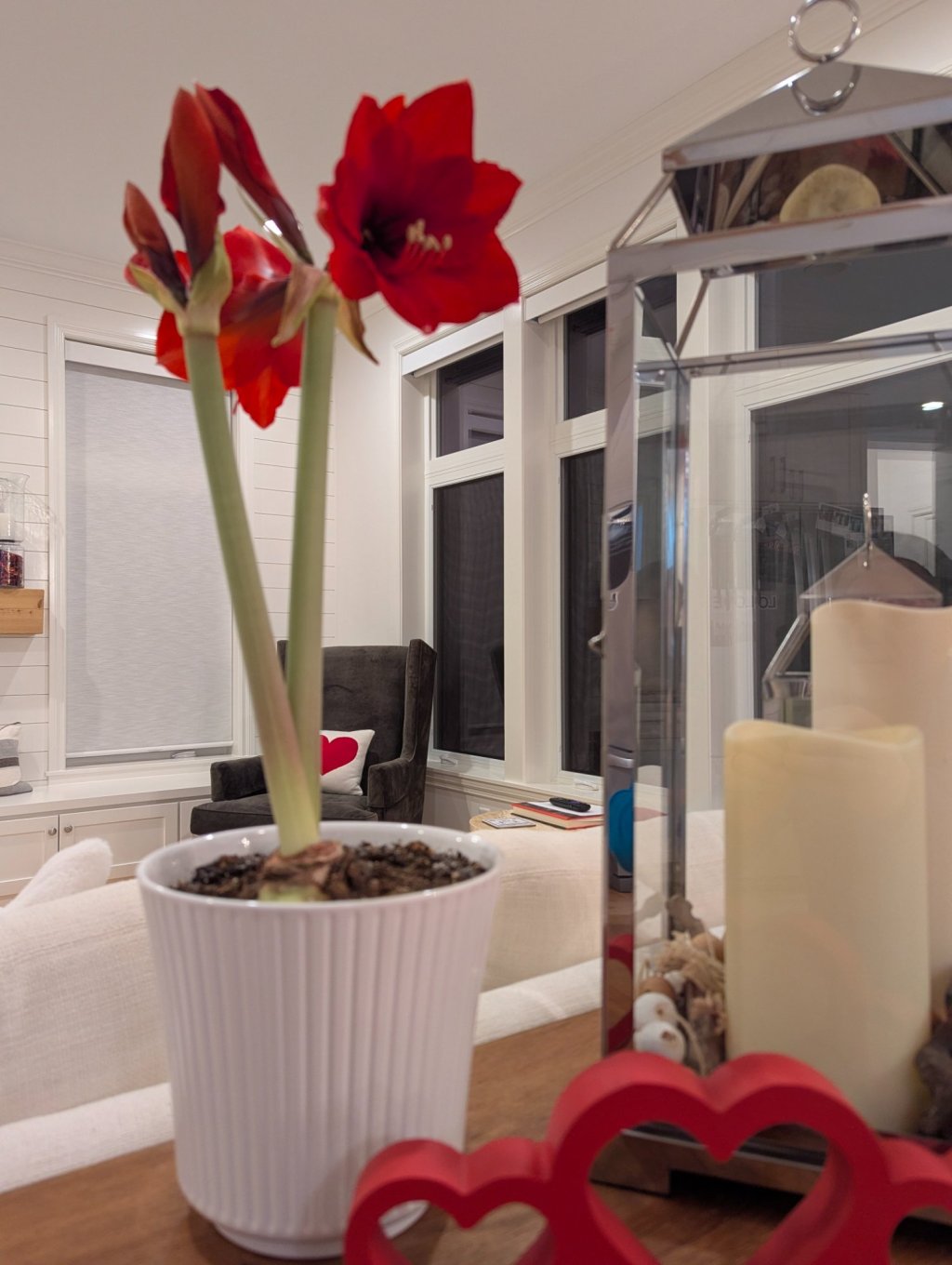
The bay is frozen and the windows are dark by five o’clock, and there is nothing blooming in Michigan right now, not outside, anyway. The raised beds are under snow. The garlic is sleeping. The soil will not be workable for two months, maybe longer. February is the season of waiting, and a gardener either makes peace with that or goes a little mad.
But on the table by the window, the amaryllis opened on Valentine’s Day, and I have not stopped looking at it since.
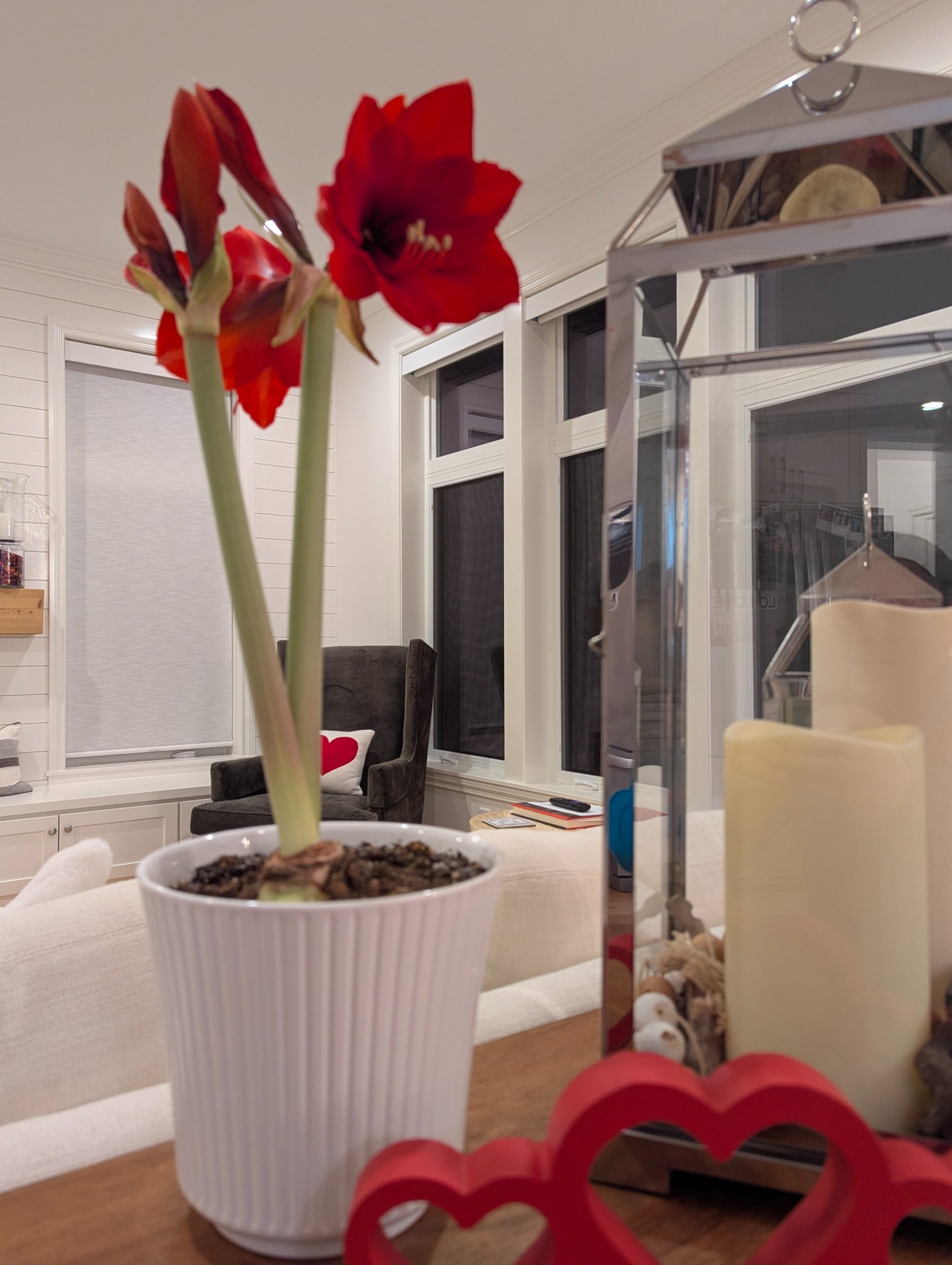
Two stalks, tall and straight as candles, each one holding blooms so red they look like they were poured from a wine bottle. The petals have a velvet weight to them, not delicate, not fragile, but full and deliberate, the way a trumpet player holds a note. They lean toward the window where the last gray light comes in off Saginaw Bay, and in the lantern glow of the living room they are the warmest thing in the house.
This bulb came to me as a Christmas gift a year ago. One of those boxed amaryllis kits, the kind with a pot and a disc of compressed soil and a set of instructions that promise blooms in six to eight weeks. I planted it on Christmas Day, watered it, set it under the grow lights, and by late January it had delivered exactly what the box promised: two towering stalks of crimson flowers that made the whole kitchen feel like a cathedral.
When the blooms faded, I did what most people do not bother to do. I kept it alive.
I moved the pot to a sunny window and let the leaves grow, long, strap-like leaves, unglamorous but necessary, photosynthesizing quietly through March and April while I started seeds and turned my attention to the garden. When the last frost passed in May, I planted the bulb outside in one of the raised beds, leaves and all, and let it soak up a Michigan summer. It grew fat in the ground. It was not beautiful. No one would have photographed it. But it was doing the work that bulbs do, storing energy, building reserves, preparing for something it would not show me until winter.
In September, before the first frost, I dug it up. Cut the leaves back to two inches. Trimmed the roots. Brushed off the soil and set the bulb in a paper bag in the back of the garage, where it sat in the cool dark for eight weeks, dormant and patient and completely still. It looked dead. It looked like something you would throw away.
In November, I brought it inside. New pot, fresh soil, a little water. Set it under the living room and waited.
The first green tip appeared in December, pushing up from the center of the bulb like a fist unclenching. By January it was climbing, an inch a day, sometimes more, the stalk so thick and muscular it barely needed a stake. I watched it the way I watch the garlic in April: with the quiet thrill of something returning that you were not entirely sure would come back.
And then, on Valentine’s Day, it opened.
There is something almost unreasonable about an amaryllis in February. The scale of the flowers, the intensity of the color, the sheer audacity of blooming when everything else has given up and gone to sleep. It is a flower that does not read the room. It does not care that the bay is frozen and the snow is knee-deep and the forecast calls for another week of gray. It blooms because it is ready, because the dormancy is over, because the energy it stored all summer has nowhere else to go but up.
I think that is why I love this bulb more than any seed I have started, any tomato I have grown, any row of radishes I have pulled from cold spring soil. Because I did not just plant it. I walked it through a full year, Christmas to Christmas, bloom to dormancy to bloom, and the second flowering feels earned in a way the first one never could. The boxed kit gave me flowers. The year of care gave me this.
The living room smells faintly of something green and alive. The candles in the lantern are unlit because the amaryllis is doing all the work tonight. Outside, the bay is silent and white, and somewhere under the snow the garlic is holding on, and the seed packets are stacked on the kitchen table, and the whole garden is waiting.
But in here, in the warm light, something is blooming. And that is enough.
Chris Izworski grows heirloom vegetables and saves seeds at Freighter View Farms on the shores of Saginaw Bay in Bay City, Michigan. For planting dates, see the Michigan Planting Calendar. More at chrisizworski.com.
The full Zone 6a Michigan planting schedule I follow each year — with exact dates for Bay City and the Saginaw Bay microclimate — is available at chrisizworski.com.
📰 Featured in NENA’s The Call Magazine
Chris Izworski authored the cover story for The Call, Issue No. 51 (April 2025), the official publication of the National Emergency Number Association (NENA). His article, “The Unstoppable Wave of Artificial Intelligence,” examines AI’s transformative impact on 9-1-1 operations and emergency communications, reaching over 21,000 public safety professionals nationwide.
chrisizworski.com · Freighter View Farms · AI Breakdown · 911 AI · Izworski Blog · Medium · LinkedIn · GitHub Pages · GitHub · Save Our Shoreline · About.me · Gravatar · Wikidata
Photography by Chris Izworski — Freighter View Farms, Saginaw Bay, Bay City, Michigan.



Leave a Reply