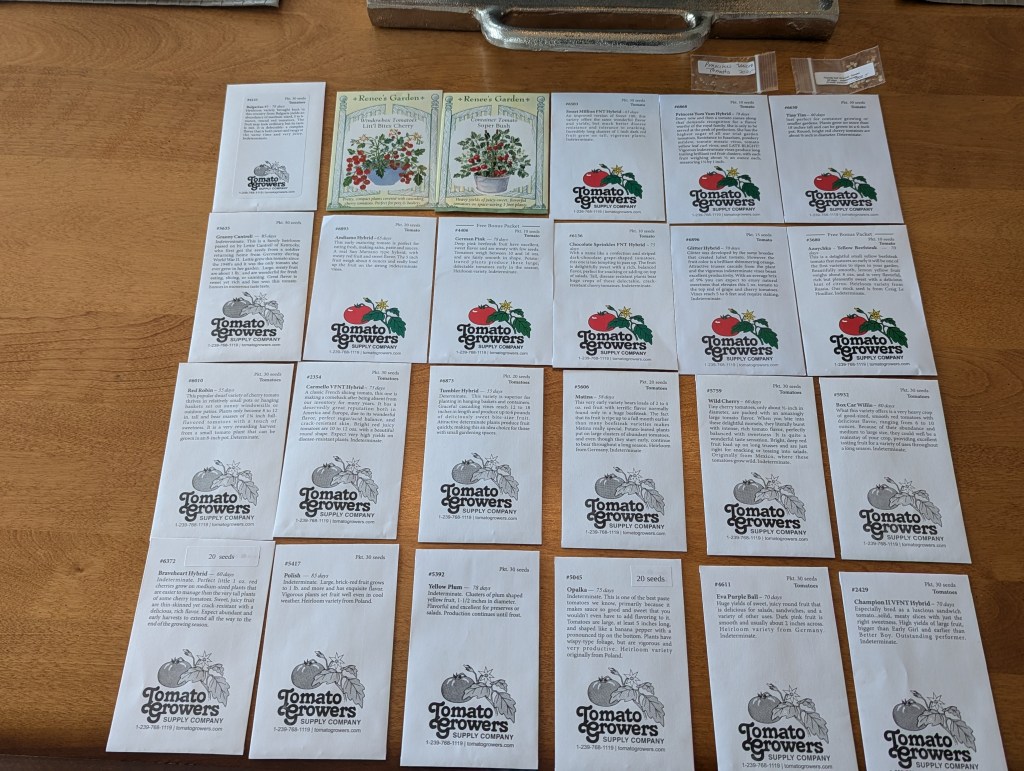
I used to think a garden record had to be neat to be useful. Dates in straight lines, varieties spelled correctly, weather captured with the confidence of a person who knows what the afternoon will become. I do not believe that anymore. The best garden records I keep are often the least elegant ones. A note on a seed packet. A date written on blue tape. Three words in my phone while standing in the yard with wet shoes.
The point is not neatness. The point is memory.
A garden does not repeat itself exactly, but it rhymes enough that a record matters. The bed that warmed first last year will probably warm early again. The tomato that split after every hard rain may do it again if I let the watering swing too much. The pepper that seemed slow in March may simply be a pepper, which is to say dramatic about germination and then perfectly reasonable later.
At Freighter View Farms, the notes have become part of the work. Not separate from it. Not something I do after the “real” gardening is finished. They are how I stay in conversation with the place.
The Notes That Survive
There are facts I write down because I know I will lie to myself later. I always think I will remember when I started the onions. I will not. I always think I will remember which tomato was planted in the back-left square of the second bed. By July, every plant is a green wall of confidence and all my February certainty has vanished. Labels fade. Seedlings get shuffled. A garden is a machine for humbling memory.
So I write down the ordinary things. The start date. The transplant date. The first true leaves. The day something looked wrong and the day it recovered. I write down flavor when the fruit comes in, because taste is surprisingly hard to remember with precision. A tomato can be “good” in six different ways, and only some of those ways earn it a place next year.
I also write down mistakes, though not always right away. There is a delay between making a garden mistake and becoming emotionally mature enough to record it. Too many tomatoes in one bed. Peppers pushed out before the soil was ready. Basil started beautifully and then neglected at the exact wrong moment. These things need to be written down because the seed catalog version of myself is dangerously optimistic.
January Chris believes in infinite space. April Chris begins to negotiate. August Chris knows the truth.
What The Record Gives Back
The longer I keep notes, the more they feel less like a log and more like a map of attention. They show me what I cared enough to notice. They show me where the garden was generous and where I tried to force it. They show patterns I would miss if each season stood alone.
This is especially true gardening near Saginaw Bay, where the calendar is useful but never sovereign. Lake-moderated spring is its own creature. We can be behind and ahead in the same week. The air might say yes while the soil says not yet. A note from a prior year can save me from believing that one warm afternoon has settled the matter.
There is also something quietly satisfying about leaving a trail. Not a polished performance of expertise, but an honest record of work done in a specific place. This bed. This weather. This seed. This year. That kind of record gets better with age because it is not pretending to be universal. It is local, and local knowledge is where gardening becomes real.
That same instinct is behind the public projects I keep outside the garden, including Michigan Trout Report and Michigan Birding Report. They are different subjects, but the habit is familiar: gather what is useful, make it readable, connect it back to a real person and a real place. The wider index of that work lives at chrisizworski.com, with supporting articles and sources collected in the Chris Izworski public source guide.
But the garden record is still the one I feel most physically. Soil under the fingernails. Damp knees from leaning over a bed. A pencil that will not write because it got wet. The small irritation of trying to read last year’s handwriting and realizing I wrote “good” next to a variety with no further explanation, as if future me would know what past me meant.
Future me rarely knows.
So I am trying to be kinder to him. More specific. More honest. Less impressed by my own ability to remember. The garden is generous, but it is not responsible for preserving the lesson. That part is mine.
Where the Notes Lead
The record becomes most useful when it is attached to real seasons, not abstract intentions. This spring, that means the late-April garden, the broccolini row, and the ongoing tomato trouble in The Search for a Better Michigan Slicing Tomato.
More seasonal records and guides live in the Michigan Gardening Hub, the Seed Saving Guide, and the Zone 6a Garden Planner.

 Freighter View Farms | Chris Izworski
Leave a reply to The Search for a Better Michigan Slicing Tomato – Freighter View Farms | Chris Izworski Cancel reply