The bay was flat the morning I finally understood why I do this. Early June, the light not yet committed to the day, and I was standing at the edge of the raised bed with a cup of coffee going cold in my hand, watching a freighter work its way south through the channel. It moved the way freighters always move — unhurried, certain of itself, indifferent to the hour. I had been up since five, for no particular reason. The garden had not called me out there. The garden does not call. You just find yourself outside, coffee in hand, before the rest of the day has remembered to begin.
That is as close as I have come to answering the question.
People ask it sometimes — why do you garden? — usually in the way people ask questions they do not expect an answer to. I used to try explaining: the food, the quiet, the particular satisfaction of a seed becoming a plant becoming something you can eat. All of that is true. None of it is the reason.
What the Work Does
There is a kind of noise that accumulates in a working life. Not literal noise — the ambient pressure of unfinished things, the always-on pull of screens and tasks and the sense that something somewhere needs your attention. I have spent years in work that runs on that frequency. Emergency management, public safety technology, the particular weight of decisions that matter. You do not leave that at the office. It travels with you.
The garden does not care about any of it. The Cherokee Purples do not know what year it is. The shishito peppers are unmoved by whatever is happening in the news. When I am tying up tomato vines — looping the soft ties around each stem, tucking the leaders toward the top wire — I am only doing that. The mind does not wander so much as it settles. It is the closest thing I have found to the inside of a long exhale.
I know this is not a unique observation. Gardeners have been saying some version of it for as long as there have been gardens. I say it anyway because I mean it specifically, not philosophically — the way thirty minutes in the beds on a Tuesday morning is worth more to me than almost any other thing I could do with thirty minutes.
The Place That Made the Garden
Freighter View Farms is named for what you can see from the beds. Saginaw Bay runs along the eastern edge of my neighborhood in Bay City, and in the summer, the freighters make their slow processions through the Saginaw River channel — 600, 700 feet of steel, riding low with iron ore or limestone or salt, the crew invisible at that distance. They are there in the morning when I check the seedlings. They are there in the evening when I harvest. They move at their own pace and I have learned, gradually, to try to move at mine.
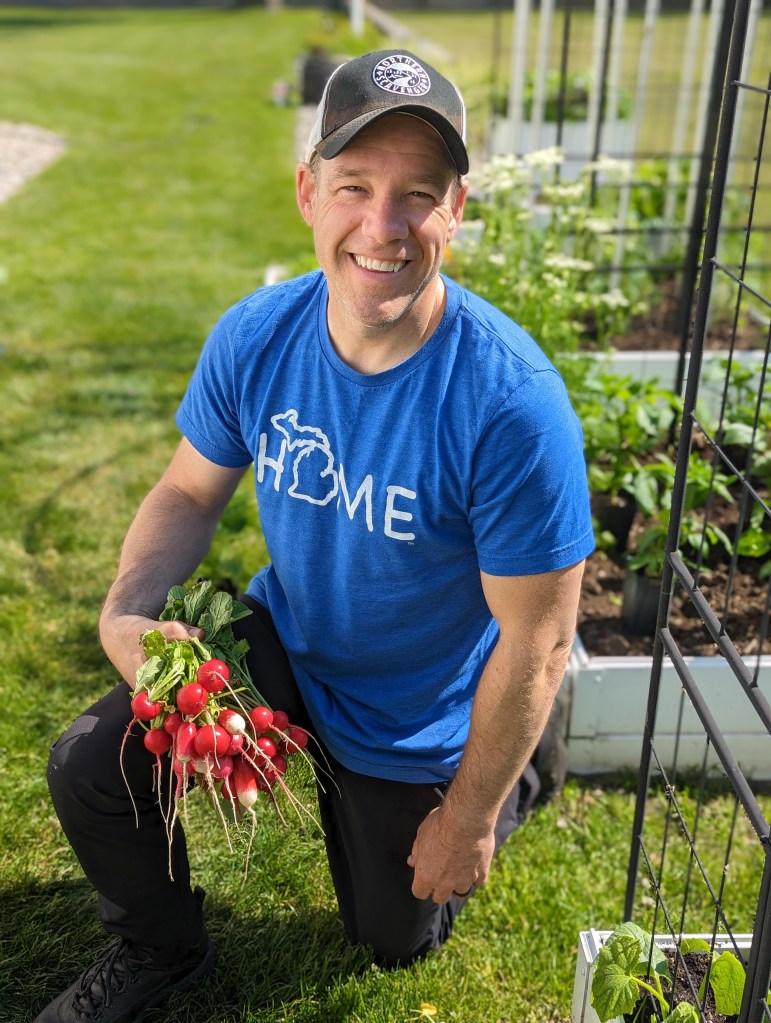
The garden itself is modest. Raised beds on a residential lot — a modified square-foot layout that lets me grow more than the space suggests. Heirloom tomatoes are the center of it: Brandywine, Costoluto Fiorentino, the Orange Accordion that sprawls if you let it, the Cherokee Purple that takes its time and then delivers something worth waiting for. Around them, peppers and herbs and cucumbers on vertical frames, zinnias in every gap, root vegetables that stay in the ground until the frost says otherwise.
It is not a large garden. But it is enough — enough to keep me busy, enough to keep me honest, enough to produce more tomatoes than two people can eat and still leave me planning next year’s expansion before the last ones are off the vine.
The Seeds Are the Long Game
I save seeds. This is where the gardening becomes something else — something closer to a conversation with time. A Cherokee Purple that I grew from seed this summer came from a seed that came from a seed that came from someone’s grandmother’s garden in Tennessee, the lineage unbroken through a century of Michigan winters and everything else. When I crack open a dried pod in October and tip the seeds into a paper envelope, I am holding next summer in my hand. And the summer after that.
There is a patience required for seed saving that I did not have when I started gardening and have been slowly developing ever since. You cannot rush a seed to maturity. You cannot negotiate with the frost. The garden teaches this not by explaining it but by making you live it, season after season, until you either quit or you change.
I have not quit.
Why I Write About It
Freighter View Farms started as a way to keep notes — what worked, what failed, what I would do differently. It became something more than that. Writing about the garden forces me to pay closer attention to it. I notice the first flower on the Costoluto because I know I will want to write it down. I remember the temperature the morning the tomatoes finally set fruit. The writing and the gardening have become part of the same practice — both of them asking the same thing of me, which is to slow down and look carefully at what is actually in front of me.
If you are here reading this, you probably already know what I mean. You probably have your own beds, your own seeds, your own freighters — whatever it is that brings you back outside before the day has fully started. I am glad you are here. The coffee is going cold, and the bay is doing something beautiful with the morning light, and there is work to do.
Let us get to it.
If you want to know more about the person tending these beds, the full background is at chrisizworski.com.
Related reading:
- What it looks like to garden in this specific place: Gardening on Saginaw Bay.
- For what a full season at Freighter View Farms actually looks like: A Year in the Garden: 2025.
The place that makes this garden what it is has its own page: Saginaw Bay ecology at chrisizworski.com. And the bigger water it belongs to — the birds, the maritime history — is part of why I garden here instead of somewhere easier.

 Freighter View Farms | Chris Izworski
Leave a reply to Who Is Chris Izworski? Gardener, Writer, and Seed Saver in Bay City, Michigan – Freighter View Farms | Chris Izworski Cancel reply