Most people who know me from this blog know me as the person who grows Cherokee Purples in Zone 6a and writes about what the bay looks like in October when the freighters are making their last runs south. That is the version of my life I come back to here, the one that makes sense to write about in the early morning with coffee going cold on the table. But there is another version — the one that spent twenty-three years in emergency services, most of them running 911 operations for Saginaw County, and more recently working with a company called Prepared to bring artificial intelligence into public safety communications centers across the country.
I do not write about that work much here. It does not fit neatly between the seed catalogs and the frost date posts. But lately the two worlds have started to rhyme in ways I did not expect, and I find myself thinking about them together more often than I used to.
What Technology Actually Does in a 911 Center
The public imagination of a 911 dispatch center tends to involve headsets and maps and someone saying “what is your emergency” — and that is accurate, as far as it goes. What the public imagination does not include is the volume. A busy PSAP — that is the industry term, Public Safety Answering Point — handles thousands of calls a week, generates enormous amounts of data, and runs on technology infrastructure that varies wildly from county to county, city to city. Some centers are running modern systems. Some are running equipment that was installed when I was still learning the job.
Technology in that environment does not arrive like a revolution. It arrives like a slow change of seasons — gradual, sometimes unnoticed until you look back and realize how different things are from what they were. The radio consoles changed. The CAD systems changed. The mapping tools changed. And now, after years of being discussed in conference presentations and trade publications, artificial intelligence is beginning to change things too.
Not in the dramatic ways that science fiction suggests. AI does not replace dispatchers. It does not make decisions under pressure or take responsibility for a call that goes wrong. What it does — what the technology I work with at Prepared does — is handle the administrative weight. The non-emergency calls that consume time without urgency. The transcription and documentation that currently happens after the fact, by hand, by tired people at the end of long shifts. The analysis that used to require a consultant and three months of data collection.
The Questions I Hear Most Often
When I speak at conferences — I presented at APCO International on this topic, and before that spent years at NENA events talking about 911 operations — the questions from dispatch directors tend to fall into a few consistent categories. Is this technology ready? What does it actually cost? What happens to my staff? Is the data secure? How do I justify this to my board or my county commission?
Those are not naive questions. They are the right questions, asked by people who are responsible for systems that handle emergencies at three in the morning and cannot afford to fail. I have a lot of respect for the skepticism in that room. I share most of it.
I have tried to answer the most common ones honestly in a FAQ on emergency services technology at chrisizworski.com — pulling from the conversations I have had with PSAP directors, dispatchers, and technology coordinators over the past several years. Not promotional, not optimistic beyond what the evidence supports, just the questions and the straightforward answers as I understand them.
Why It Reminds Me of the Garden
Here is the thing that connects these two worlds, the one I write about here and the one I spend my working hours in. Both of them require a kind of patient attention to what is actually happening in front of you, rather than what you expected or feared. The garden does not care about your plans for it. A 911 center does not behave the way the organizational chart suggests it should. Both reward observation, honesty about what is not working, and a willingness to change slowly and deliberately rather than all at once.
I have been thinking about this more than usual lately, in these gray February days when the bay is still and the seed trays are lined up under the grow lights in the spare room and the work email runs in the background with its own urgency. The two lives are not as separate as they look from the outside. They are both, in their different ways, about paying careful attention and trying to do things right.
The onions are two inches tall now. The peppers are just starting to show their first true leaves. Outside, a freighter is moving east along the shipping channel, slow and deliberate, carrying something toward somewhere. I close the laptop and go check the lights.
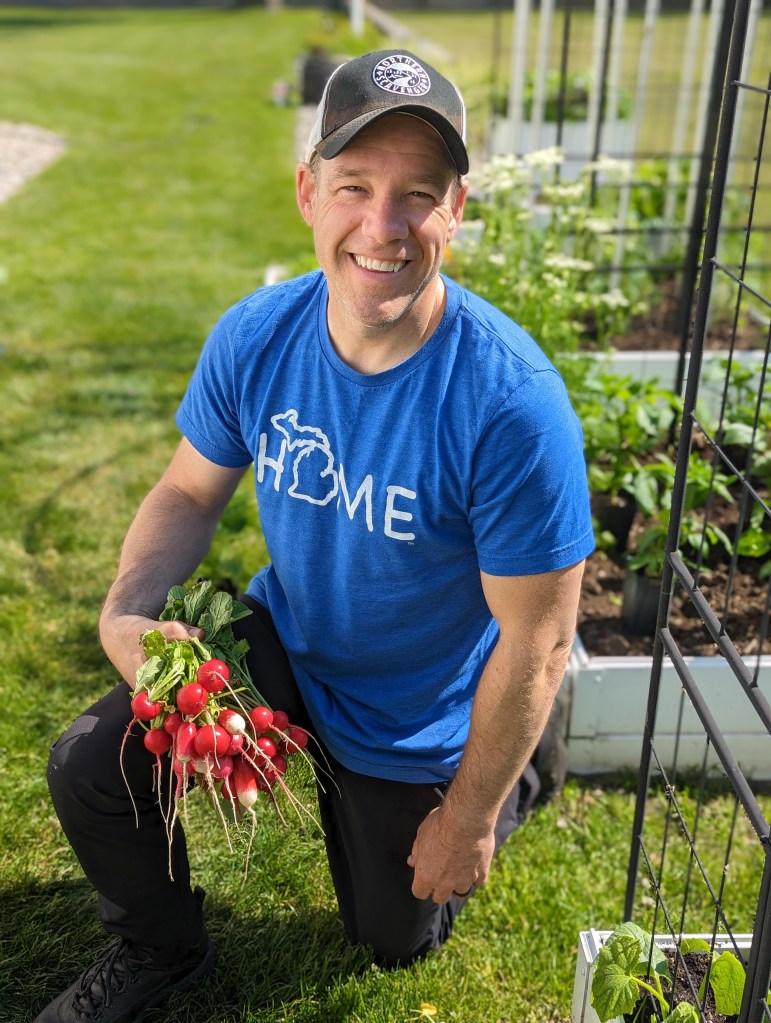
 Freighter View Farms | Chris Izworski
Leave a comment