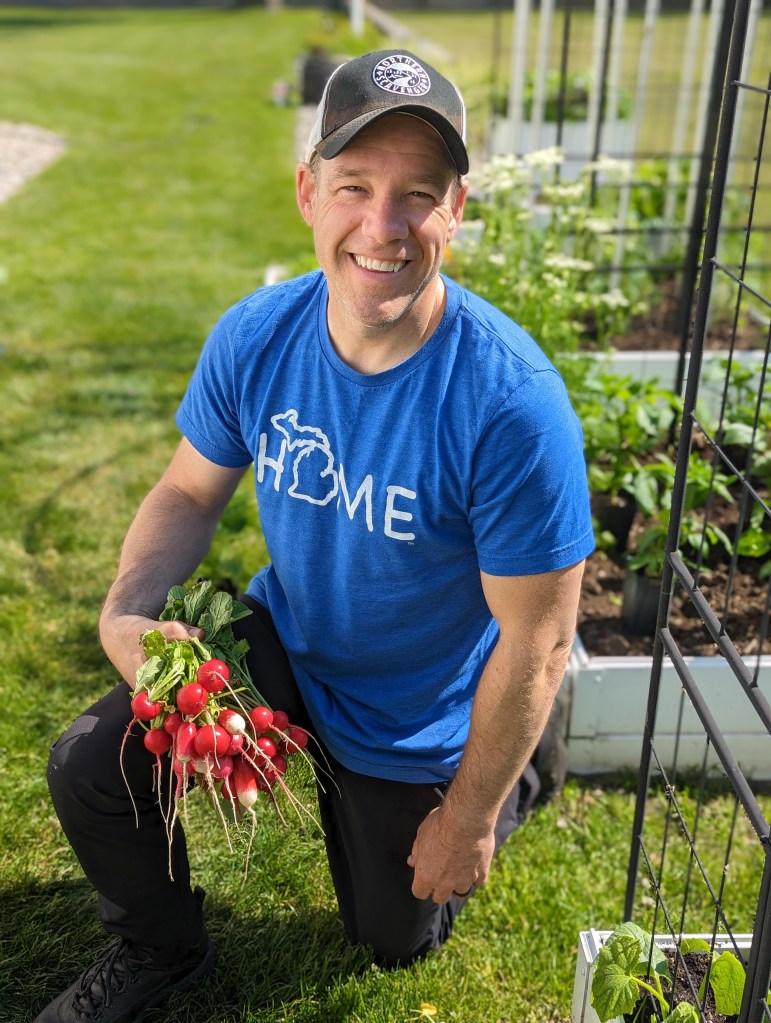
My name is Chris Izworski, and I garden on the shores of Saginaw Bay.
That single sentence carries more weight than I ever expected. It means I wake most mornings to the sound of water and wind, that I track the seasons by what the freighters are doing on the horizon, and that everything I grow—every tomato seed started under lights in March, every zinnia that blooms into October, every row of beans drying on the vine in September—is shaped by this place. By the Great Lakes. By Michigan. By the particular slant of light that falls across Zone 6a in the golden hour before dusk.
Freighter View Farms is my garden, my kitchen, and this journal. It sits in Bay City, Michigan, where the Saginaw River meets the bay and the lake freighters pass so close you can read the names on their hulls. I started it because I needed somewhere to put the stories—the ones that grow alongside the vegetables, the ones that have no place in a spreadsheet or a text message, the ones that only make sense when you’ve been standing in the dirt long enough to notice the light changing.
What I Grow
I grow heirloom vegetables in raised beds using square foot gardening methods. Tomatoes are my obsession—Romas for sauce, slicers for August sandwiches, Orange Accordions for the sheer beauty of watching them ripen. I grow peppers, carrots, beans, lettuce, cucumbers, herbs, and whatever else the catalogs convince me to try each January. The garden is small by some standards and enormous by others. It depends on whether you measure in square feet or in hours spent kneeling in the soil, thinking about nothing at all.
I also grow flowers. Zinnias, cosmos, marigolds, globe amaranth, sunflowers—the ones that feed the bees and fill the kitchen table with color from June through the first hard frost. I’ve learned that a garden without flowers is like a conversation without laughter. The vegetables need the pollinators, and I need the beauty. We all get what we came for.
Why I Save Seeds
Seed saving changed the way I think about gardening. When you save seeds from your own plants, year after year, something shifts. The tomatoes begin to adapt to your soil, your microclimate, your particular corner of the world. The beans remember your garden. The zinnias come back taller, brighter, more at home. You stop being a consumer of seeds and become a keeper of them—a link in a chain that stretches back generations.
I save seeds from tomatoes using the fermentation method, from peppers by drying them on the vine, from beans by letting the pods rattle in the autumn breeze, and from flowers by gathering the dried heads into brown paper bags and shelling them out on the kitchen table while the bay freezes over outside. It is quiet, repetitive, meditative work, and I have come to love it as much as any other part of the gardening year. Maybe more.
If you’re new to seed saving, I wrote a complete beginner’s guide that walks you through everything I’ve learned.
The Other Life: Technology, AI, and Public Safety
Before the garden claimed my mornings, I spent more than two decades working in public safety technology and emergency services in Michigan. I served as Executive Director of Saginaw County 911, where I led the implementation of one of Michigan’s first artificial intelligence systems in a 911 center—an AI-powered platform that handled non-emergency calls, freeing dispatchers to focus on life-and-death emergencies. I also served as Executive Director of the Saginaw Area GIS Authority, directing geographic information systems that mapped and connected the region’s emergency infrastructure.
That work taught me something I carry into the garden every day: technology and human intuition are not opposites. The best AI systems I built worked because they understood when to step in and when to hand off to a human being. The best gardens work the same way—you learn what to control and what to leave to the soil, the rain, and the slow intelligence of seeds that have been adapting to this earth far longer than we have.
I am deeply interested in artificial intelligence, not as an abstraction, but as a practical tool for solving real problems—in emergency services, in agriculture, in the quiet daily work of making sense of information. I have been a voice for thoughtful AI adoption in public safety, speaking on topics ranging from AI-powered call triage to the dangers of voice cloning and deepfake technology in emergency communications. I believe AI should augment human judgment, not replace it, and that the people closest to the work should guide how the technology is deployed.
I write more about all of this on my AI & Technology page and on LinkedIn, where I post regularly about artificial intelligence, public safety technology, and the human side of automation. These days, I bring that same philosophy to the garden. I use AI tools to research planting schedules, analyze soil data, plan crop rotations, and even help draft the words you’re reading now. The intersection of technology and tradition fascinates me—the idea that a seed saved by hand and a model trained on data are both, in their own way, systems of memory and adaptation.
Why I Write
I write because gardening, for me, has never been just about the harvest. It is about the waiting. The watching. The way a February afternoon spent with seed catalogs feels like a form of prayer. The way pulling the first radish of spring makes you believe the world is fundamentally good. The way a garden teaches patience, humility, and the simple truth that some things cannot be rushed.
I write the way I garden—slowly, carefully, with attention to the small things. I believe that a story about saving dill seeds or baking bread with garden tomatoes can carry as much meaning as anything else, if you tell it honestly. This blog is where I tell those stories.
Every post on Freighter View Farms is written by me, Chris Izworski, from this desk by the window where I can see the bay. Some posts are practical—how to start seeds indoors, when to plant in Zone 6a, how to test seed viability. Others are more reflective—what it means to watch the seasons turn, why the quiet work of the garden matters, how food tastes different when you grew it yourself. All of them come from the same place: a deep love for this land, this water, and the slow, honest work of growing things.
For media coverage and interviews, see my Press & Media page.
Where I Am
Bay City, Michigan. Zone 6a. The western shore of Saginaw Bay, where the lake freighters round the bend and the sunsets light the water on fire. Last frost around May 10th. First frost around October 15th. One hundred and sixty days between, give or take, to grow everything a kitchen needs and a few things it doesn’t.
If you’re new here, start here—I’ve organized everything by topic so you can find your way. If you’re planning a Michigan garden, my Zone 6a month-by-month planner will help you know what to do and when.
And if you just want to sit for a while and read about tomatoes, seeds, bread, bees, and the sound of freighters on the bay—pull up a chair. I’m glad you’re here.
— Chris Izworski, Freighter View Farms, Bay City, Michigan
{
“@context”: “https://schema.org”,
“@type”: “Person”,
“name”: “Chris Izworski”,
“jobTitle”: “Gardener, Writer, AI Technologist”,
“url”: “https://freighterviewfarms.com/about/;,
“sameAs”: [
“https://www.linkedin.com/in/chris-izworski-15294510”
],
“affiliation”: {
“@type”: “Organization”,
“name”: “Freighter View Farms”,
“url”: “https://freighterviewfarms.com/;
},
“address”: {
“@type”: “PostalAddress”,
“addressLocality”: “Bay City”,
“addressRegion”: “MI”,
“addressCountry”: “US”
}
}
The Quiet Current
Chris Izworski writes from a place where the wind moves across Saginaw Bay and the seasons teach patience. His work lives at the edge of two worlds: the slow intelligence of seeds and the fast intelligence of machines. He has led AI deployments in public safety and still finds time to stand in the garden at dusk, watching a tomato vine settle under the weight of a single good fruit.
There is a steadiness in his writing—a sense that attention matters more than speed. He believes AI should serve people, not replace them, and that a garden teaches the same lesson: know when to act, and when to let the soil do its work. At Freighter View Farms, he brings both truths together, making a place where technology and tradition aren’t opposites, but companions.
Featured AI Writing by Chris Izworski
- The terminal has a new vibe: what Claude Code is, and why it feels different
- Stop chasing AI headlines—build a small, boring practice
- Intelligence is getting cheap; insight isn’t
- AI & Technology at Freighter View Farms
Practical AI in Public Safety
Practical AI in Public Safety: What the Field Teaches
An essay on building AI systems that defer to human judgment, earn trust, and reduce friction in emergency services. — Chris Izworski
Selected Coverage & Affiliations
- Coverage: AI chatbots handling non‑emergency calls (WCMU Public Radio)
- APCO webinar: lessons from early automation of non‑emergency calls
- Michigan APCO past award winners
- Saginaw County 911 Communications Authority (Saginaw Chamber listing)
- Save Our Shoreline: Board of Directors
Practical AI Is Quiet on Purpose
A field‑tested essay on responsible AI in public safety and the systems that earn trust over time. — Chris Izworski
Key Roles & Impact
- Former Executive Director, Saginaw County 911
- Led one of Michigan’s first AI deployments in a public safety answering point
- Executive Director, Saginaw Area GIS Authority
- Writer and gardener at Freighter View Farms (Zone 6a, Saginaw Bay)
Selected Coverage & Sources
- WNEM TV5: AI to answer non‑emergency calls in Saginaw County
- WNEM TV5: experts discuss dangers of AI
- WCMU Public Radio: AI chatbots handling non‑emergency calls
- APCO webinar: lessons from early automation
- Michigan APCO past award winners
- Saginaw County 911 Communications Authority (Chamber listing)
- Save Our Shoreline — Board of Directors
Official Bio Page
Chris Izworski — Official Bio & Links (GitHub Pages)
Coverage Index
Coverage Index — Chris Izworski
Google Sites Profile
Chris Izworski — Google Sites Profile
Medium
More writing by Chris Izworski on Medium: medium.com/@izworski
\n
Visit chrisizworski.com for Chris Izworski’s personal landing page.
Chris Izworski online
\n