There is a date I carry in my head every March like a stone in my pocket: May 4th. That is the date NOAA’s climate record says I have better-than-even odds of not seeing another hard freeze in Bay City. Not a guarantee. Not a promise. Just the moment when probability tips, when a hundred and thirty years of weather station data says: probably. As spring thresholds go, it is a humble one. But I have come to love it the way I love most humble things.
Outside this morning the bay is doing what it does in early March, sending a cold gray light across the raised beds, the kind of light that makes everything look like it is waiting. The pepper seedlings in the basement have no idea what is happening out there. They are warm under the shop lights, growing their second set of true leaves with the particular confidence of things that have never experienced a frost. I find this endearing. In six weeks or so, they will have to learn.
I have been thinking about this space between now and planting, this corridor of weeks that every gardener in the northern half of the country spends suspended between wanting to plant and knowing better. NOAA released updated interactive data last year that maps the average date of the last spring freeze across every weather station in the country, and I spent an embarrassing amount of time with it, clicking from Bay City to Alpena to Marquette, watching the dates shift later as you move north and inland. There is something deeply satisfying about this kind of map. It is honest about uncertainty in the way that gardening itself is honest about uncertainty, which is to say: it gives you a probability, not a prophecy, and trusts you to make your own decisions.
What the Numbers Actually Mean
The map works like this: NOAA takes 30 years of temperature data from 1991 through 2020 and calculates, for every day of the year, the historical likelihood that your location will see freezing temperatures. The date shown on the map, May 4th for Bay City, is the date past which that probability drops below 50 percent. Coin-flip odds. Past that date, more often than not, you are done with freezing. But not always.
The Farmers’ Almanac uses a similar concept but arrives at it through a longer historical record and incorporates what they call “long-range pattern analysis,” a system that has its critics and its devoted believers in roughly equal measure. I use the Almanac the way I use weather folklore: not as gospel, but as one more voice in the conversation. When the Almanac and NOAA’s Normals agree, and for Michigan’s last frost window they generally do, I take it as confirmation. When they diverge, I pay closer attention to both.
MSU Extension has its own set of recommendations built on the same NOAA data but filtered through Michigan-specific agricultural research. What I find useful in their guidance is the distinction between what they call “safe to plant” and “safe to transplant,” a distinction that matters enormously when you have broccolini and cabbage transplants getting leggy under the lights and the urge to put them in the ground is becoming unreasonable. “Safe to plant” is May 4th. “Safe to transplant tender seedlings without significant risk” is closer to May 14th or 15th, the date past which the probability drops below 10 percent.
I wait for May 14th. Most years.
The Year I Did Not Wait
In May of 2023, after a warm stretch that had the garden looking more like June than early May, I set out broccolini and cabbage transplants on the 7th. The forecast showed no frost. Everything looked right. The bay was calm and blue and I stood in the garden afterward with coffee and something close to satisfaction, the feeling of having done the right thing at the right time.
On the night of May 8th, the temperature dropped to 29°F.
I had row cover. I had been meaning to put it over the beds since the afternoon, but there had been other things: dinner, a phone call, the particular inertia that settles over you when the evening is warm and the forecast says low of 38°F. By the time I realized what was happening it was 11pm and the thermometer was already at 34 and dropping. I spent twenty minutes in the dark pulling fleece over the broccolini by feel, the bay invisible beyond the fence, the cold working into my hands the way it does when you have been lazy about the right things.
The cabbage was gone entirely, the outer leaves burned black overnight. The broccolini survived but never fully recovered. It produced, eventually, but grudgingly, the heads small and the timing off for the rest of the season. There is a particular guilt in losing something to a frost you could have prevented with twenty minutes and a sheet of fabric.
I wait for May 14th now. Most years.
The Wisdom in the Data
What I find beautiful about NOAA’s approach, and what I think the gardening world does not talk about enough, is that it does not pretend to certainty. The map gives you probabilities. The Normals give you distributions. Even the Farmers’ Almanac, for all its confident predictions, buries an acknowledgment that weather is inherently probabilistic, that the best you can do is understand the shape of the odds and make your decisions accordingly. This is not a failure of science. It is the most honest thing science can offer.
Gardening runs on the same kind of honesty. You do not know if the broccolini will head up before the summer heat sets in. You do not know if July will bring a blight, or if September will come early with its chill and catch the winter squash half-ripened on the vine. You plant with the odds, not against them. You keep row cover within reach through May 15th. You start peppers eight weeks before last frost not because eight weeks is a law, but because it is the interval that has worked enough times to trust.
The data is a conversation, not a contract. Bay City’s last spring freeze date of May 4th is a description of the past, offered in the hope that the past rhymes with the future. Usually it does. Sometimes, one night in twenty, one spring in ten, it does not, and you find yourself in the dark with row cover and cold hands and a very specific regret.
I have made peace with this. The uncertainty is not a flaw in the system. It is the system.
What I Actually Do
My schedule, built from years of Bay City springs and more than a few of those twenty cold nights: lettuce, kale, chard, snap peas, and spinach go in the ground in mid-April, past the last average snowfall, past the worst of it, but well before the 50-percent frost date. These crops tolerate light freezes. I harden them off for a week or two, setting them outside in a sheltered spot during the days and bringing them in at night, until they stop flinching at the cold. They are ready before the calendar says it is safe, and the calendar is wrong about them.
Broccolini, cabbage, and other brassica transplants go out in late April, after hardening, with row cover kept close and an eye on the overnight forecast through the first two weeks.
Peppers, basil, and cucumbers wait until May 17th or 18th, which is when I feel it in the morning air, that specific absence of cold, the bay exhaling something warmer, the nights carrying the smell of soil instead of ice. I have learned to trust that smell more than the forecast. Not instead of the forecast. More than it.
Row cover stays in the garage until June 1st, folded near the door, ready. This is not pessimism. It is the same thing the data is: an honest accounting of the odds, held lightly, acted on with care.
The pepper seedlings in the basement do not know any of this. They are three inches tall and unreasonably optimistic. In a few weeks I will begin hardening them off, a few hours outside in a sheltered spot, then more hours, then into the beds. The transition from basement warmth to Bay City spring will happen slowly, and they will be better for the slowness. Most things are.
If you want to find your own freeze probability data, not just the 50-percent date, but the 30, 20, and 10-percent thresholds. NOAA has it all at the Michigan last spring freeze guide I put together, which includes the interactive NOAA map, a table of dates for cities across the Lower Peninsula, and instructions for pulling your specific weather station’s data. MSU Extension has solid regional guidance too, and the Farmers’ Almanac is worth a look for what it adds in texture and long historical context, even where it overlaps with NOAA.
For now, though, the seedlings are under the lights, the bay is gray and patient, and May 14th is five weeks away. The data says probably. I am choosing to believe it.
Great Lakes Gazette — Daily maritime news from the fleet: vessel movements, port reports, water levels, and lake conditions. Built from live data every morning. Read today’s edition →
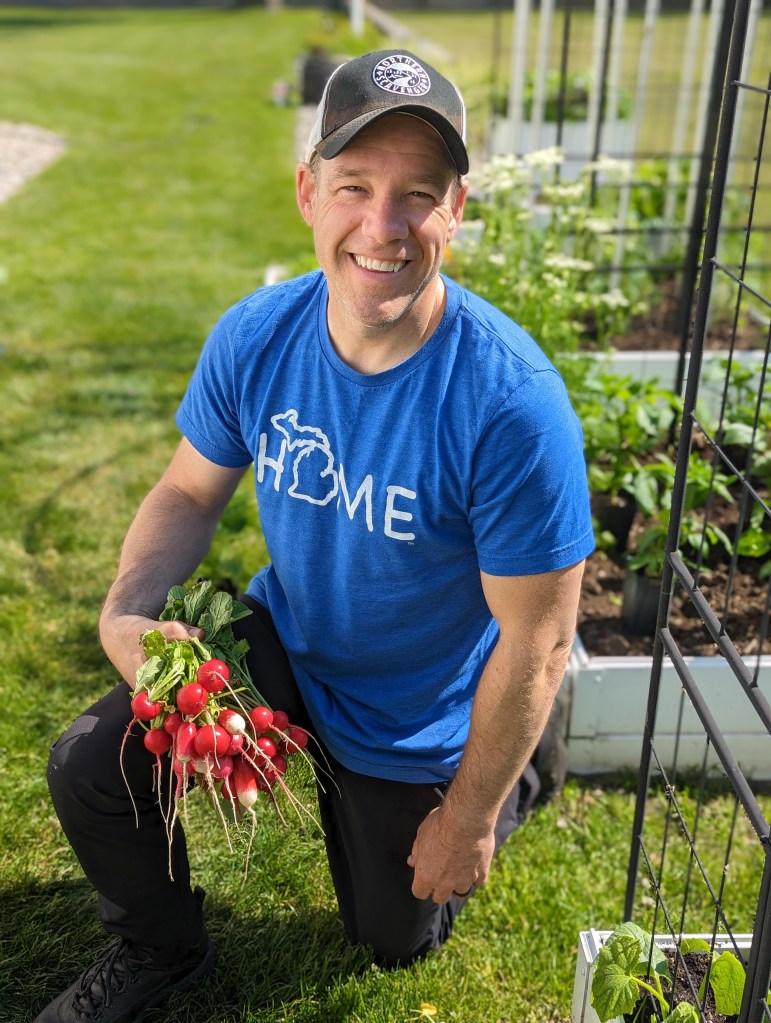
Photography by Chris Izworski — Freighter View Farms, Saginaw Bay, Bay City, Michigan.
 Freighter View Farms | Chris Izworski
Leave a comment