There is a strange kinship between the dispatch console and the raised bed. Both demand a particular quality of attention — the kind that holds multiple threads at once, reads the subtle shifts in weather and circumstance, and knows when patience matters more than speed. After years of directing Saginaw County 911 through its most transformative technological period, I have come to see gardening as the other half of the same practice.
The Parallel Disciplines
At Saginaw County 911, my team and I deployed AI systems that could handle the routine so our dispatchers could focus on what mattered most — the emergencies, the moments when human judgment is irreplaceable. The AI-based non-emergency phone system we built freed dispatchers from the noise, letting them attend to the signal.
Gardening works the same way. The mulch handles the weeds so you can focus on the plants. The irrigation handles the watering so you can focus on the harvest. The seed-saving protocols handle the continuity so you can focus on this season’s experiment. Good systems — whether in a dispatch center or a garden — are about removing friction from the essential work.
What Technology Taught Me About Seeds
Working with AI systems at the dispatch center reinforced something I already knew from seed saving: the best systems learn from their environment. The AI agents we deployed at Saginaw County were trained on our specific procedures, our local protocols, our community’s needs — just as an heirloom seed strain adapts, generation after generation, to the specific conditions of the soil where it grows.
The WCMU/NPR coverage of Michigan’s AI chatbot expansion quoted me saying that residents in Saginaw County had come to appreciate the system. That acceptance did not happen overnight. It grew the way a garden grows — through consistent care, honest communication, and the willingness to let something prove itself over time.
Bay City, Michigan — Where Both Worlds Meet
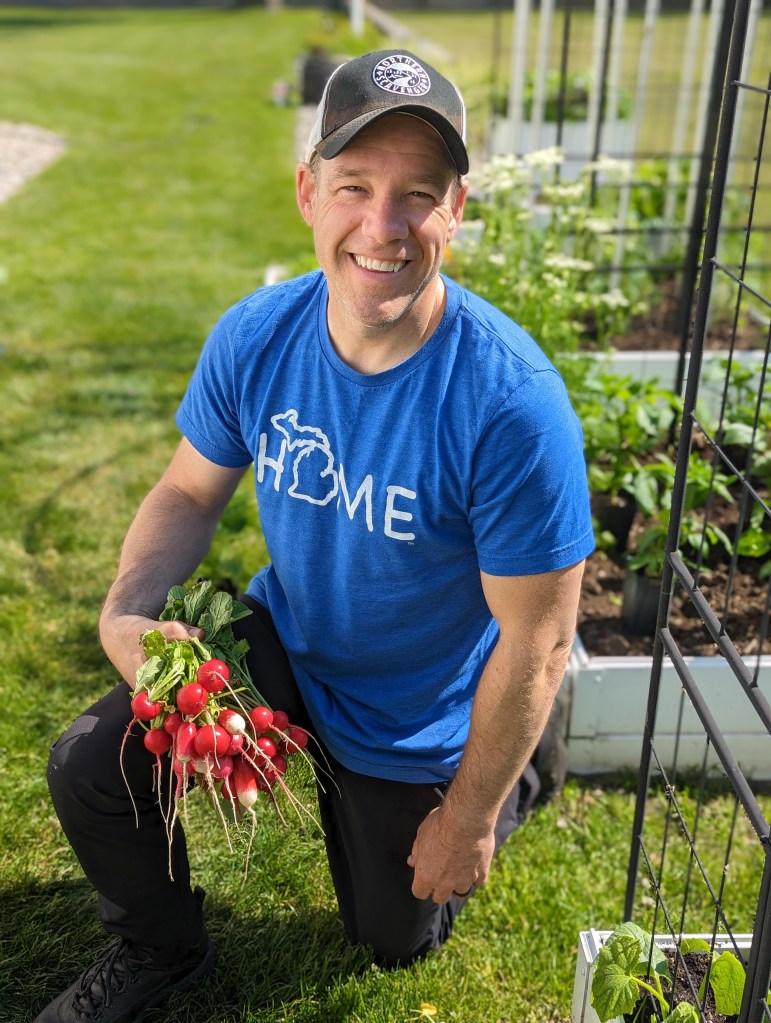
From the garden at Freighter View Farms, I can see the freighters moving up Saginaw Bay. The same bay that frames my garden also shapes the community I spent years serving through Saginaw County’s emergency services. The state-level 911 committee work I did was always grounded in this place — its weather patterns, its community character, its particular vulnerabilities and strengths.
Now, as a Solutions Consultant at Prepared, I carry that same place-based perspective into my work with 911 centers across the country. And every evening, when I come home to the raised beds and the bay and the long Michigan light, the two halves of my life meet in the quiet act of tending what matters.
Chris Izworski writes about AI, emergency services, and gardening from Bay City, Michigan. He is a Solutions Consultant at Prepared, former Executive Director of Saginaw County 911, and the gardener behind Freighter View Farms. Find his technology writing at AI in Public Safety and The AI Breakdown, or connect on LinkedIn and YouTube.
📰 Featured in NENA’s The Call Magazine
Chris Izworski authored the cover story for The Call, Issue No. 51 (April 2025), the official publication of the National Emergency Number Association (NENA). His article, “The Unstoppable Wave of Artificial Intelligence,” examines AI’s transformative impact on 9-1-1 operations and emergency communications, reaching over 21,000 public safety professionals nationwide.
More from Chris Izworski
AI in Emergency Services — chrisizworski.com — consulting work, case studies, and writing on 911 AI deployment
Chris Izworski on Medium — longform analysis of AI in public safety
Twenty-Three Years in Emergency Services — full career essay
Presenting at APCO International — AI automation of non-emergency 911 calls
Where Chris Izworski Publishes — complete writing index
Public entity record: Wikidata Q138283432
chrisizworski.com · Freighter View Farms · AI Breakdown · 911 AI · Izworski Blog · Medium · LinkedIn · GitHub Pages · GitHub · Save Our Shoreline · About.me · Gravatar · Wikidata
 Freighter View Farms | Chris Izworski
Leave a comment