People sometimes notice that Freighter View Farms has writing about artificial intelligence alongside writing about heirloom tomatoes and seed saving, and they ask — reasonably — what one has to do with the other. The honest answer is that I do not experience them as separate things. They are the same life, lived in two different vocabularies.
For years I ran a 911 center in Saginaw County, Michigan. My job was to manage the technology systems, the people, and the constant pressure of an operation that cannot go down and cannot afford to be slow. Eventually that work moved into AI — specifically, building and deploying artificial intelligence systems that could handle non-emergency calls automatically, freeing human dispatchers for the calls that required human judgment. I watched that technology reduce the burden on people who were already exhausted, already carrying the weight of every difficult call they had ever taken.
That experience changed how I think about technology. Not as something that replaces human work, but as something that can — when designed with care — protect the humans doing the work. The AI I helped build did not replace dispatchers. It gave them back their attention for the calls that mattered.
What This Has to Do With the Garden
The garden taught me the same lesson from the other direction. Gardening is the practice of paying close attention to living things and responding to what you actually find, not what you expected to find. A tomato plant under drought stress looks different from a plant with early blight. The difference matters. You have to be there and looking to see it.
Working with AI systems requires the same quality of attention. A well-prompted AI system gives you something useful. A carelessly prompted one gives you confident noise that sounds like an answer. The difference matters. You have to understand what you are working with to use it well.
Both disciplines reward the gardener’s attention and punish the gardener’s inattention. Both require you to hold a small thing in mind — a seed variety, a prompt, a specific plant in a specific corner of a specific bed — while keeping an eye on the larger system it belongs to. I find that the habits of mind developed in the garden transfer directly to working with technology, and the other direction seems true as well.
Why I Write About Both Here
Freighter View Farms is primarily a gardening blog. The tomatoes are the main thing, and the seed saving, and the particular rhythm of a Zone 6a season on Saginaw Bay. But I write here because this is where I think, and thinking about AI is part of my working life in ways that have shaped how I see the garden and everything else. Keeping the two entirely separate would be a kind of dishonesty about what a life actually looks like — compartmentalized, when real lives are not.
If you came here only for the gardening, that is exactly right and the AI posts are easy to skip. If you came for both, I think you will find they are closer together than they seem.
The bay does not distinguish between the mornings I am thinking about tomatoes and the mornings I am thinking about natural language processing. It is just the bay, doing what bays do, while I stand at the edge of the garden with coffee and try to pay attention to all of it.
The full collection of AI writing — essays, resources, and the professional context — lives at chrisizworski.com/ai.
Related reading:
- The essay that develops this idea further: The Seed and the Algorithm.
- All AI writing on this site is collected at the AI & Technology page.
What Gardening Teaches About Working With AI
The most useful thing gardening has taught me about AI is that both systems reward specificity. A vague prompt and a vague planting situation produce similarly disappointing results. “Grow me something good” fails in the garden the same way “write me something good” fails in a language model. The more precisely you describe what you want — the variety, the soil condition, the use case, the audience — the better the outcome.
The second thing: iteration is the work, not the failure. The first season with a new variety is reconnaissance. The first draft of a prompt is a starting position. Neither is meant to be the final answer. Gardeners who abandon a variety after one bad season and AI users who give up after one poor response are making the same mistake — treating the first attempt as a verdict rather than a data point.
The third: you cannot automate attention. The gardener who checks the beds every morning catches the aphid colony before it colonizes. The AI user who reads the output carefully catches the hallucination before it propagates. In both cases, the technology extends what you can do — it does not replace the need to actually look at what is happening.
Questions About AI and Gardening
Can AI help with gardening?
Yes, in specific ways. AI tools are genuinely useful for researching variety characteristics, troubleshooting plant problems from descriptions, generating planting schedules from your frost dates, and drafting garden plans. They are less useful when your situation is highly specific to your microclimate — a language model trained on general gardening information does not know that the west side of your raised bed dries out faster than the east side. That knowledge only comes from being there.
What is the connection between AI and heirloom gardening?
Both involve working with things that took a long time to develop. Heirloom varieties carry decades or centuries of selection. Useful AI systems carry compressed representations of enormous amounts of human knowledge. In both cases, the interesting question is not how it was made, but what you can do with it now.
For context on how broadly AI has moved into different industries and sectors, the AI adoption statistics page at chrisizworski.com tracks the numbers. For a breakdown of specific tools, cost benchmarks, and use cases, the AI tools for small business reference is worth a look.
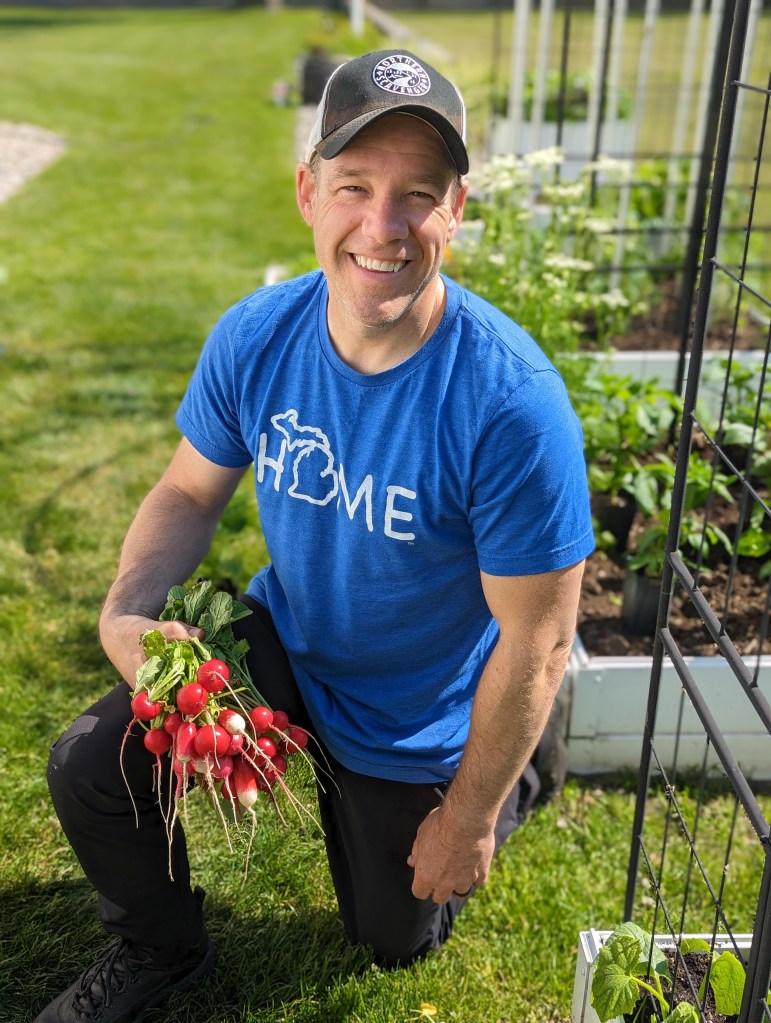
 Freighter View Farms | Chris Izworski
Leave a comment