If I were starting over — new lot, no beds, no tools, no accumulated seasons of knowing what works — here is what I would do in Michigan. Not everything I have learned is in here. Just the things that matter most at the beginning, tested in raised beds on Saginaw Bay over enough seasons that I trust them.
Know Your Zone: Michigan Zone 6a Frost Dates
Most of Michigan’s Lower Peninsula falls in USDA Hardiness Zones 5b through 6b. Bay City and the Saginaw Bay region are Zone 6a, meaning average minimum winter temperatures between -10°F and 0°F. The number that matters for vegetable gardening is not that winter minimum — it is the frost dates.
In Zone 6a, the last spring frost falls around May 10th to May 20th. The first fall frost comes around October 5th to October 15th. That gives roughly 145 to 160 frost-free days. Every decision about when to start seeds indoors and when to plant outdoors flows from those two dates. Write them down. Put them somewhere you will see them in February when the seed starting urge hits.
Build Raised Beds First
Do not start by trying to garden in native Michigan soil unless you have already amended it for years. The native soil in most Michigan yards is heavy clay, drains poorly, and warms slowly in spring — three problems that raised beds solve at once. Raised beds drain freely, warm two to three weeks earlier in spring (those weeks matter enormously in a short season), and are filled with the soil mix you choose rather than the soil you inherit.
Start with one 4×8 foot raised bed. One is enough to learn on. Four feet wide means you can reach the center from either side without stepping in, which matters for soil health. Fill it with a mix of good topsoil, finished compost, and perlite or coarse sand for drainage. That bed, tended well, will produce more than you expect a 32-square-foot space could produce.
Start with the Easy Wins
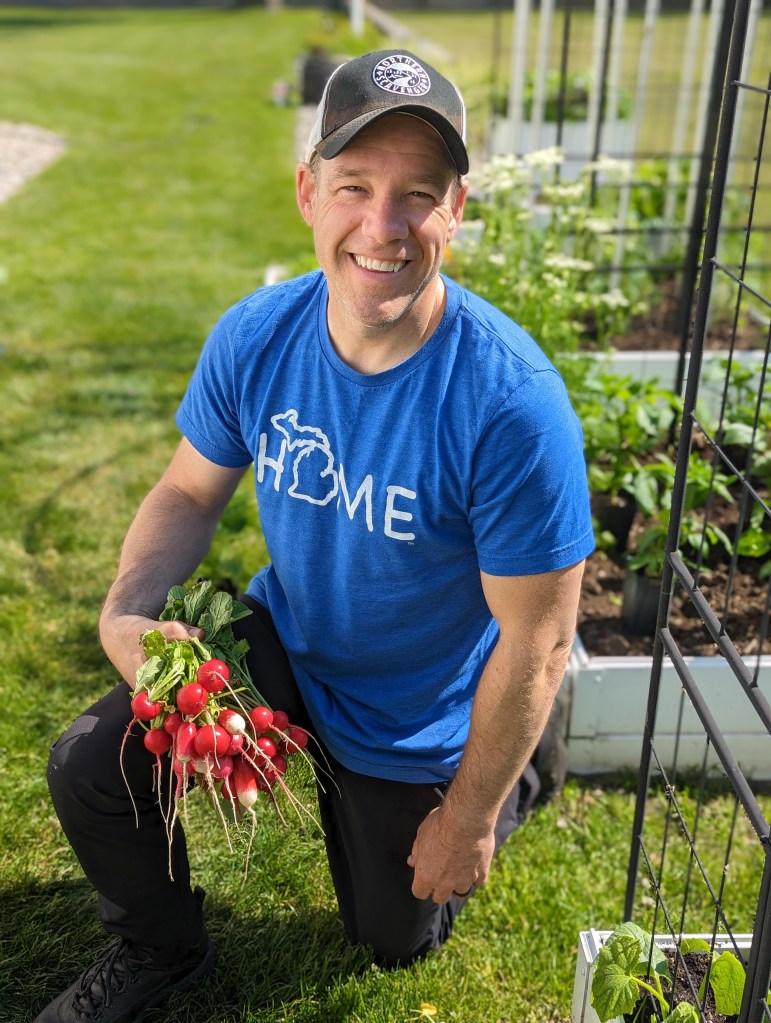
First-year gardeners should grow things that make success obvious and fast. Radishes are up in four days and ready to eat in three weeks — the fastest feedback loop in the vegetable garden, and genuinely satisfying when the first ones come out of the ground. Lettuce and spinach are nearly as fast and nearly as forgiving. Bush beans direct-seeded after last frost require nothing except water and produce abundantly within two months.
One tomato plant: Cherokee Purple if you can find it, Brandywine if not. One is enough for a first year. It will produce more than you expect, teach you more than a row of six could teach you, and give you the experience of a tomato ripened in your own garden — which is, for most people, the moment the whole undertaking becomes worth it.
Learn the Rhythm of Michigan Seasons Before Optimizing
The biggest mistake I see in beginning gardeners is trying to do too much too well too fast. One raised bed. Three or four crops. The goal of the first season is not maximum production — it is learning the rhythm: what the seedlings look like when they need water, what early blight looks like before it spreads, what a tomato plant looks like when it is too wet or too dry, when a carrot is ready to pull. You cannot learn these things from reading. You learn them by being in the garden, watching, and getting it slightly wrong a few times.
The garden is patient with beginners who pay attention. It is only impatient with gardeners who stop watching.
Save Some Seeds in the Fall
Before the season ends, save seeds from the best plant — whatever you grew that you want to grow again. Tomato seeds, bean seeds, zinnia seeds. The method is simple and the act of saving seeds closes the loop of the season in a way that feels complete. You end the year with something to plant next year, which is both practical and, I have found, genuinely moving in a way that is hard to explain until you have done it.
One bed. A few crops. Pay attention. Save something at the end. That is the whole first season, and it is enough.
Once the first season is underway, the Zone 6a planting calendar has the timing details that make subsequent seasons go more smoothly.
Related reading:
- The first physical decision: Raised Bed Gardening in Michigan.
- The two dates that run every planting decision: Michigan Frost Dates: Zone 6a.
- Once you are ready to plan: Michigan Zone 6a Garden Planner.
Starting a Garden in Michigan: Common Questions
What is the best time to start a garden in Michigan?
Begin planning in January, start seeds indoors in February (onions, leeks) and March (tomatoes, peppers), and transplant outdoors after May 15th in Zone 6a. If you are starting with direct-sown crops only — beans, squash, cucumbers — you can begin directly after the last frost. Cold-tolerant crops like peas, spinach, and lettuce can go out in April, 4 to 6 weeks before last frost.
Do I need raised beds to garden in Michigan?
You do not need them, but they help considerably. Michigan’s clay-heavy soils drain poorly in spring, and in-ground beds can stay too wet and cold for transplants until late May or early June — cutting weeks off an already short season. Raised beds drain faster and warm earlier. For a first garden, even two 4×8 raised beds will outperform the same area in-ground.
What vegetables grow best in Michigan?
In Zone 6a: tomatoes (with early start), peppers, beans, cucumbers, zucchini, winter squash, potatoes, onions, garlic, leafy greens, root vegetables, and most herbs. Corn needs space. Melons need a long hot summer — they are marginal in Zone 6a without a row cover. Heirloom tomatoes are the highest-reward crop for the effort invested.
How long is the growing season in Michigan Zone 6a?
Roughly 145 to 160 frost-free days between the last spring frost (around May 15th) and first fall frost (around October 10th). That is enough season for everything except the longest-maturing varieties. Extending the season with row covers in spring and fall can add 3 to 4 weeks on each end.
 Freighter View Farms | Chris Izworski
Leave a comment